
2026-27
Here you will find unique descriptions for our 2026-27 upper-level courses.
For most upper-level courses, the prerequisite is six credits of second-year English, third-year standing, or by permission of the instructor. See prerequisites for individual courses.
Note: Any course descriptions or reading lists here are tentative.
Course descriptions: Fall 2026
English 312: History of Critical Theory
Professor Mike Roberson

This historical survey of literary theories from Plato to the Moderns will rely on two broad approaches. First, we will consider aesthetic and literary statements from the perspective of M.H. Abrams and his four orientations of literary theory. These orientations—the mimetic, the pragmatic, the expressive, and the objective—offer an historical and a practical approach to understanding criticism. Second, we will consider aesthetic and literary statements as they engage in a long history of attacks against and defenses of art and literature. This dynamic will help show how art and literature has always manifested out this fight between convention and innovation. Along the way, we will explore how literary theories reflect and challenge the politics and philosophies of their times.
English 326: Topics in Globalization and Culture
Professor Melissa Stephens

Stories link to survival, dreams, and liberation. We need stories to imagine alternate worlds, where hope, curiosity, laughter, joy, care, and rest become central. In this course, we will explore courageous stories of community, radical works of imagination, and inspired acts of protest over global capitalism, environmental collapse, surveillance cultures, police states, and more. We will engage with diverse creators of poetry, fiction, essay, song, theory, film, and social media. Join this class to reimagine global communities alongside dreams of interspecies kinship, mutual aid, and collective liberation.
English 331: Topics in West Coast Literature
Professor Toni Smith
An examination of the literature of British Columbia and the West Coast of North America. Topics may include orality, fusion literatures, Indigenous literatures, exploration and travel, settlement and expansionism, environmentalism, regionalism, politics, culture, identity, and others.
English 342: Topics in Renaissance Literature
Professor Sarah Crover
A study of 16th-century literature within the broader social, political, philosophical, and cultural contexts of the age. Topics may include lyrical poetry, drama, courtly love, humanism, utopian literature, and others. Focus may be on a single author or genre.
English 348: Topics in 18th-Century Literature
Professor Daniel Burgoyne
Gothic Revolutions
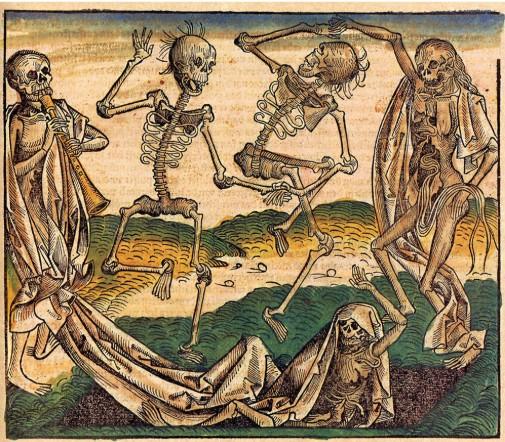
This exploration of the late 18th century will focus on the rise of the Gothic as a literary genre. Gothic writing emerges mid-century as if reacting against the confidence of the Enlightenment or anticipating the upheaval and dissolution of social orders. Gothic novels become a staple of circulating libraries, symptoms of growing literacy among the lower and middle classes. The Gothic links medicine, the body, crime, and psychology, and thus provides a unique and provocative vantage from which to study the eighteenth century.
English 352: Topics in 20th–Century Literature
Professor Clay Armstrong
This course will examine selected works of the American writer James Baldwin. Readings may include the novels Go Tell it on the Mountain (1952), Giovanni’s Room (1956), and Another County (1962); short stories from Going to Meet the Man (1965); and non-fiction writing such as from Notes from a Native Son (1955) and The Fire Next Time (1962). Beyond the primary texts, the course will examine Baldwin’s relationships with literary figures including Richard Wright and Lorraine Hansberry, and with political figures including Medgar Evers, Malcolm X, Angela Davis, and Martin Luther King, Jr. Students will further survey the surge in recent scholarship on Baldwin, such as by Eddie Glaude Jr. and Nicholas Boggs.
English 390: Word and Image
Professor Paul Watkins
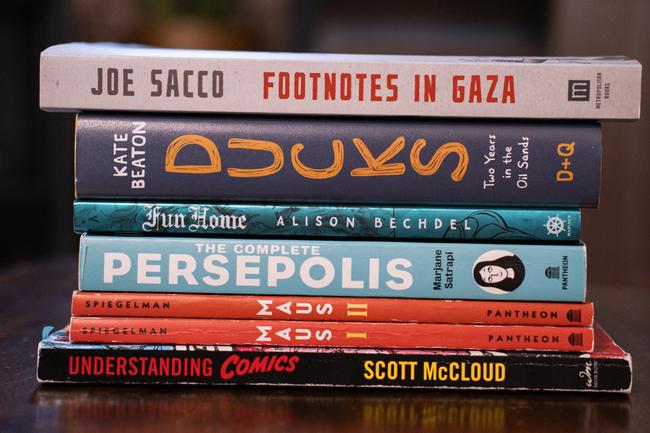
English 390 investigates intersections between word and image in an emergent genre loosely defined as graphic memoir, or what others have called “autographics” (Gillian Whitlock), “graphic narrative” (Hilary Chute), “graphic-novel memoir” (David Itzcoff), or “comics journalism” (Joe Sacco). Along the way, we explore how graphic texts push the boundaries of literature and memoir. We also delve into the intricate relationship between popular culture, politics, and art. A few texts include Maus by Art Spiegelman, Persepolis by Marjane Satrapi, and Ducks: Two Years in the Oil Sands by Kate Beaton. The final text will be chosen from two options through a class vote.
Note: This course deals with mature subject matter.
Course Descriptions: Spring 2027
English 314: Modern Critical Theory
Professor Sally Carpentier
A survey of literary theory including Russian Formalism, Structuralism, New Criticism, Marxism, Feminism, Post-Colonialism, Post-Structuralism, and others. Each theory may be examined for its assumptions, applications, and textual strategies. This course will introduce the tools of criticism and a wide range of critical perspectives.
English 327: Topics in World Literature
Professor Farah Moosa
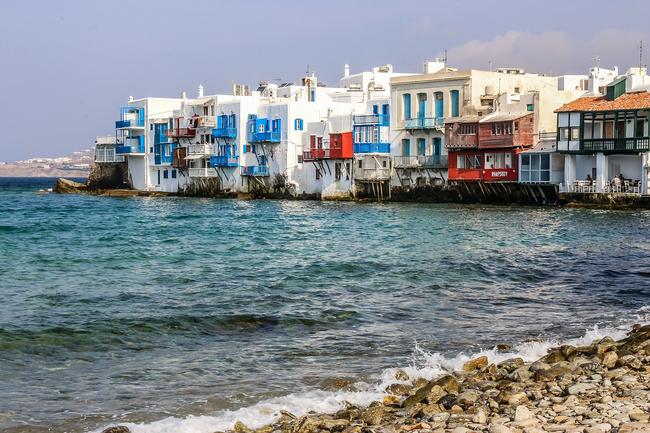
Join us as we read contemporary international texts that explore themes of war, love, resiliency, and perception. The stories we will encounter are captivating and often beautiful, though they also speak of difficult pasts, presents, and/or futures. Many of our selected texts have won major literary awards. As such, we will also think about what makes them prizeworthy.
English 328: Gender and Sexuality in Literature
Professor Neil Surkan

Queer Ecology at the Beginning of the End (of the World) (?)
In this course, we will study how contemporary LGBTQ2S+ authors (with an emphasis on poetry) fight for both queer liberation and climate justice in ways that exemplify the field of Queer Ecology (a term coined by Catriona Sandilands). In our readings, we’ll notice how queer desire and intimacy play a unique role in the way a speaker or narrator navigates their relationship with the fragile, precarious natural world. In “Postcolonial Love Poem,” for instance, Natalie Diaz captures a sensual moment between lovers under unpredictable skies: “the rain will eventually come, or not. / Until then, we touch our bodies like wounds.” And in the poem “Recycling” by Henri Cole, the speaker considers the limits of his agency and legacy in the face of environmental collapse: “Me – I have no biological function and grow / like a cabbage without making divisions / of myself. Still I have such a precise feeling / of the weeks recycling, of a stranger’s arrival, / and the tumult righting itself.” Notably, and as can be seen in the above examples, optimism still resides at the heart of this course, despite the ominous present. These brave and brazen authors, via complex interplays of hope, honesty, and intimacy, will remind us that delight can be a powerful political position.
English 329: Topics in Children’s and Young Adult Literature
Professor Janet Grafton
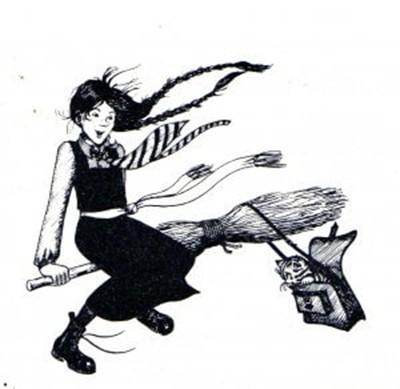
Witches are some of the most recognizable characters in children’s literature, from the hags of fairy tales to young witches such as Sabrina and Kiki. In this course, we will engage in a survey of children’s and YA fiction and trace the reinvention of the witch from evil to empowered within these genres. Conducting close readings from a range of literary formats, we will explore what this cultural shift reveals about attitudes to and relationships with gender, power, and age.
Possible readings could include fairy tales such as Baba Yaga, novels such as Baum’s The Wonderful Wizard of Oz, Dahl’s The Witches, and Murphy’s The Worst Witch, and graphic novels such as Leyh’s Snapdragon, and Ostertag’s The Witch Boy.
English 330: Speculative Literature
Professor Anna Atkinson
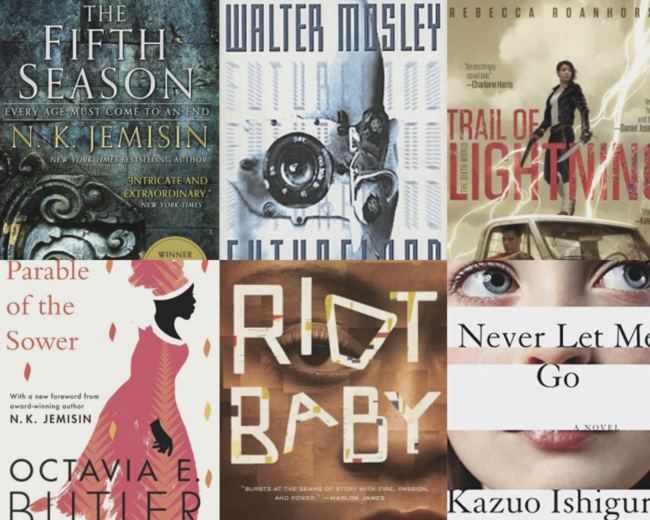
It’s an under-represented fact that the writers of apocalypses, at the time of the genre’s formation (in the Middle East, several millennia ago), were all either Indigenous peoples whose lands were occupied by invading forces, or people who had been taken captive and removed from their homeland. Once this is understood, the fact that speculative fiction, which indulges in apocalyptic envisioning quite often, has historically tended to be the domain of white male authors, becomes very curious indeed. In fact, many apocalyptic works have managed to reverse the “polarity” of the genre, and to promote narratives that reinforce white supremacy, heteronormativity, and misogyny. And of course, religious bigots have been using the Biblical apocalypse to do the same for generations.
However, a growing number of incredibly talented writers from BIPOC communities are publishing in this genre, returning to its roots as a narrative that gives voice to the oppressed. All of the works on this course speak to the fact that for many marginalized communities, as for the Ancient Jews who wrote the apocalyptic texts in the Bible, the apocalypse as an event, as opposed to a genre, has already happened. If you, like me, belong to a culture whose world hasn’t ended, be ready to accept that this is a position of incredible privilege. And be ready to allow the authors in the course to “lift the veil” (which is what apocalypse means) to see what the apocalypse can look like, and signify.
English 332: Topics in Indigenous Literatures
Professor Amelia Horsburgh
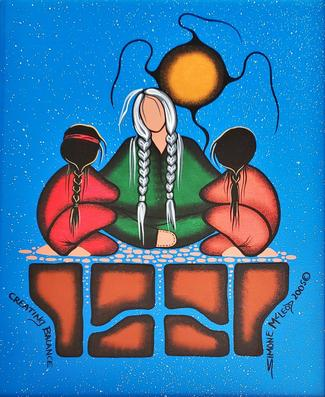
In our course, the Trickster is not the only one having a giggle, as we study Indigenous literatures written in Canada and how these authors make use of humour to subvert and challenge colonial narratives and oppressive structures. Our topic will spotlight humouristic qualities and tropes used to parody, mock, and laugh at authority. Moreover, these texts work to build reconciliation, justice, and strength both within Indigenous communities and with settler Canadians. Select authors may include Eden Robinson (Haisla and Heiltsuk), Tomson Highway (Cree), Drew Hayden Taylor (Ojibwe and white ancestry), Frances Koncan (Anishinaabe and Slovene), Kim Senklip Harvey (Silx, Tsilhqot’in, Ktunaxa, and Dakelh), and Richard Van Camp (Dene).
English 344: Topics in Shakespeare
Professor Sarah Crover
A study of the works of Shakespeare. The course may focus on various representations of particular Shakespearean plays or on a variety of Shakespeare's works. Topics may include performance, the London Stage, film adaptations, transformations of identity and power, public freedom, and others.
English 350: Topics in 19th-Century Literature
Professor Ian Whitehouse

Arthur Lovejoy argues that Romanticism should not be seen as a single event but as a plurality of intellectual and literary movements. This course will explore Romanticism(s) through the distinct lenses of Mary and Percy Shelley and Jane Austen, demonstrating in the process that all three critique their age in distinct but important ways. From the no-name monster in Frankenstein to the poetics of “A Defence of Poetry” through to the search for a balance between reason and emotion in Sense and Sensibility, they all challenge the Enlightenment’s portrait of the rational autonomous agent, cautioning about the limits of reason and advocating for the importance of emotion. Beginning with the philosophical, political, and cultural contexts of their time, this course will argue that these writers explored that which makes us truly human. From the need for human connection to the necessity of finding a balance in life, from the transformative power of nature to the resilient power of love, their works continue to invite us to consider what it means to be human.