
Index by year
2024-25
Makayla Taylor
Essay Contest Winner in the in the Upper-level Category, Best Essay, 2024-2025
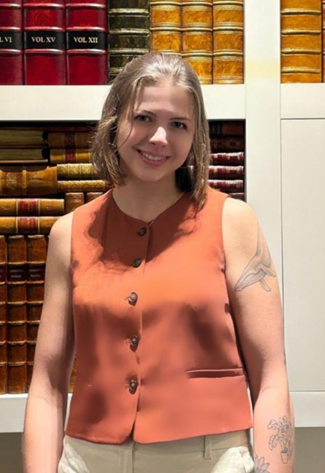
Makayla has completed her Bachelor of Arts with major in English and minor in Liberal Studies at VIU. Before commencing law school, she will pursue her passion for languages as an English language assistant in Quebec. From a young age, Makayla has expressed a keen interest in literature and language. She believes that stories encourage readers to lose themselves in the labyrinths of another person’s mind and explore the world through various lenses. Reading about personal accounts of love, loss, beauty, and pain reminds her of the universality of the human experience, reinforcing the values of empathy and compassion.
The way language can be constructed to eloquently convey such tales has been a longtime fascination for Makayla, and that’s what drew her to the dynamic, interactive English classes offered at VIU. Studying the Italian Renaissance in Florence (as part of the Liberal Studies field school) led Makayla to discover a new area of academic interest. While Italy is perhaps most widely recognized as the site of the seminal “rebirth,” Dr. Sarah Crover’s English Renaissance course (ENGL 342) recentres the movement and its extensive effects to England. Reading the course description instantly piqued Makayla’s curiosity as she sought to build upon her knowledge of the Renaissance and better understand its global impact. With the overarching theme of “conversions,” Dr. Crover’s course asked students to consider how profound artistic, corporeal and spiritual conversions arose from the literature of the period.
One of the subthemes listed on Dr. Crover’s syllabus sparked Makayla’s interest: “translation as conversion.” Under this subtitle were Psalms 52 and 139 by Mary Sidney Herbert, Countess of Pembroke. Although Makayla had never previously studied the Psalter, the selected Sidney psalms captivated her with their eloquence, evocativeness, musicality. Transformed into poetic form, these psalms carry a harmony that re-aligns them with their history as song. Learning that the Sidney Psalter emerged during a period of high religious and political strife indicated to Makayla that the Sidneys approached the poetic translation of the psalms with the prospect of spiritual conversion, and seeing how translated literature can shake the foundations of a society and redefine deep-seated cultural values pulled Makayla toward the topic of psalm versification. Her essay is important to her because its argument approaches language as a mode of conversion, underlining the ripple effects that can result from altering literary form. The fact that Pembroke was one of the few female writers of the era also inspired Makayla to write about her — to recognize her not only as “an aristocratic lady” or “the brother of Philip Sidney,” but as her own person, one who sophistically wove her political arguments into her psalms. Amongst the many voices contained within the Sidney Psalter, Makayla sought to amplify and preserve Pembroke’s subdued voice.
Ranking first on the list of Makayla’s favourite texts is Dante’s Divine Comedy (c. 1308-1321), for its vivid illustrations of spiritual development, striking descriptions of the afterlife, and exploration of perennial topics such as free will and divine justice. Next is Plato’s Republic (c. 380 BC), a Socratic dialogue centred on justice and education regarding the healthy soul. As with many of Plato’s works, it may leave you with more questions than answers. And thirdly, Michael Oondatje’s The English Patient (1992) is a historical novel set at the end of WWII that examines the interactions between four distinct characters, evocatively conveying how compassion, interdependence, and memory serve as the glue to human connection. Each of these texts displays the key sign of a good book: offering new insights with every re-read.
Peter Olinger
Essay Contest Winner in the in the Innovation Category, Best Essay, 2024-2025
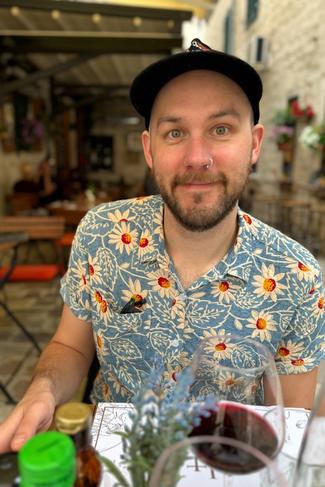
Peter graduated in the spring and will begin the BEd post-baccalaureate program in the Fall of 2025. He has always been interested how stories shape us personally and culturally, so he especially appreciates that English classes at VIU gave him the tools to pick apart literature to find meaning while providing space to hear the perspectives of other students who had come up with entirely different (but equally valid) meanings from literary works.
Peter went into Dr. Paul Watkins’ ENGL 390 course with an appreciation for graphic novels as (largely underappreciated) great works of fiction, but, outside of some Alan Moore and Frank Miller (as well as Persepolis for a class the previous semester), he had read very few. He is thrilled to attest that he adored every book on Dr. Watkins’ course reading list.
His One of a Kind Award-winning essay, “Engineering Realities: Historical and Emotional Truths in Art Spiegelman’s Maus and Joe Sacco’s Footnotes in Gaza,” stemmed from his belief that truth and authenticity are pillars of what makes great art — an aspect he believes is under-investigated. Here’s how he describes his essay’s starting point: “both Sacco and Spiegelman playfully but earnestly approach their roles as sculptors, shaping grave real-world events into compelling pseudofiction…the writing process helped me understand my own feelings on what in literature, and art more broadly, constitutes ‘truth.’”
If asked to describe his favourite texts, Peter feels it’s necessary to limit the scope to recent favourites and recent must-reads—otherwise, texts risk getting “lost in the sauce.” First, he celebrates Ta-Nehisi Coates’ latest book, The Message, about perspective-altering trips Coates took to Senegal, North Carolina, and Gaza. Peter especially appreciates how the book is equal parts self-reflection, a reflection on the craft of writing, and a reflection on contemporary politics. He believes Coates is an essential voice in a political ecosystem that threatens writers like him. Next, Peter recommends the film Sing Sing. The looming presence of mass incarceration is felt throughout the film, but he believes that what elevates it to the heights it achieves is its dedication to personal and interpersonal moments of self-reclamation of humanity within prison walls. Outstanding performances and cinematography are the icing on the cake for this one. Finally, but with the caveat that he believes something put out by the Disney corporation doesn’t need any help, Peter thinks that Andor achieves the really outstanding feat of incorporating a deep historical understanding of the systemic operation of fascism as well as the innerworkings of revolution into a show set in the Star Wars universe.
(He’s also been rereading The Lord of the Rings this last summer to satisfy his nostalgia.)
Peter’s advice for English students is to take electives in the Social Sciences. Many of his best term papers were born out of interdisciplinary connections he drew between literary works and articles he read for sociology, poli-sci, history, and even geography classes. He notes that even though there seems to be a fair amount of crossover between English and History majors, he almost never saw his English classmates in other Social Sciences courses, which is a trend he’d love to see change!
In reflecting on his degree, Peter would like to express his deep appreciation to every prof he had the pleasure of taking classes with, as well as the many fellow students who (perhaps unknowingly) expanded his appreciation of the works being discussed in class. He believes his knowledge and abilities have been massively improved by the community of professors and students at VIU in the two years he has been in Nanaimo, and he appreciates this opportunity to publicly thank all of them. He’d also like to make special shout-outs to Dr. Sarah Crover and Dr. Paul Watkins, who both believed in his work enough to nominate him for extra recognition during his time at VIU.
Gabriel Young
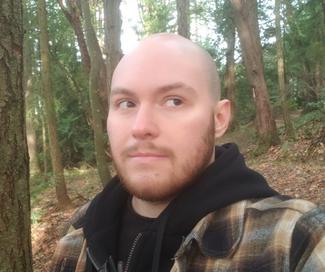
Essay Contest Winner in the Second-Year Category, 2024-2025
If all goes as planned, Gabe Young is currently at the halfway point for his bachelor’s degree in English. As a long-time reader and writer, Gabe has always felt a passion for literature, and his studies at VIU’s English Department have helped to introduce him to brilliant works of literature that he otherwise might not have found. Studying in the English department has also helped him to understand these texts more deeply and to write about what he reads with clarity. His award-winning essay, “‘Nothing Beside Remains’: Ephemerality and the Fallacy of Power in ‘Ozymandias’ and ‘The Ruin,’” originated in Neil Surkan’s ENGL274 on Literary Traditions; Gabriel was initially drawn to this seminar because he felt it important to know the historical contexts of the works he was studying, but also because he “love[s] history, and the chance to examine the connections between contemporary and historical English literary works was too good to pass up.” He chose to focus on Percy Bysshe Shelley’s “Ozymandias” because it tops his lists of favorite poems and favorite works of English literature, and has inspired Gabriel’s own writing. He was similarly draw to Old English poem “The Ruin” because, despite the poem’s age (8th or 9th century AD), it “still persists so vividly in the present…” Finding the poems engagingly similar despite the great expanse in time between them, Gabriel was ultimately inspired in his essay by both poems’ expression of “how humans have always, in a way, been ourselves.”
When he is not reading ancient works of poetry, Gabriel enjoys the TV series Severance (2022-), the Temeraire (2006-2016) historical fantasy novel series by Naomi Novik, as well as the video game Disco Elysium, which is “the best book [he’s] ever played.” Despite their differences in form and content, Gabriel is challenged by the texts’ shared demonstration of insightful worldbuilding, which inspires his own writing. Other areas of academic focus are biology (minoring) as well as a few history courses (dabbling). Amidst reading, writing, and studying, Gabriel can usually be found creating things or spending time in nature or with animals. Finally, no stranger to the English Dept’s essay awards, Gabriel offers this helpful advice to current and future English students: “Don't leave everything until the last minute. Procrastination is the mind-killer. It's the little death that brings total obliteration of your sleep schedule. This is advice that I'm still trying to internalize.” Useful advice for us all!
Brendan Wanderer

Essay Contest Winner in the First-Year English 135/FILM Category, 2024-2025
“Flexing the arts muscles got me thinking deeply about life,” shares Brendan Wanderer, a VIU Creative Writing/Visual Arts student in the final throes of the degree. “When I look back to moments when I connected in meaningful ways with school,” he continues, “it all came down to storytelling and self-expression.” Likely there’s no better place to make such a connection than in an English class, so when Brendan took Daniel Burgoyne’s Literature and Criticism (English 135) course in Spring 2025 he embraced the challenge as opportunity. He admits that the course subjects—AI, androids, and space operas—weren’t in his comfort zone, but that didn’t stop him. In fact, his essay, “Robots Need Love Too: Masking, Othering, and the Politics of Being Seen in Klara and the Sun” won the English Department essay competition in its respective category. “In reading Ishiguro’s Klara and the Sun,” Brendan states, “I saw in Klara a familiar—sharing much with my own story.” Elaborating on this correspondence, he reveals that he “experience[s] life through a neurodivergent lens” and used that to rethink Klara’s character—despite that Klara is actually an AI being. “I saw a unique angle and an opportunity to build a bridge for those unfamiliar with autistic masking—to glimpse how challenging it can be to operate in a world that caters to neurotypicals—and to highlight the importance of meaningful accommodations.” That desire to build empathy and widen one’s perspective is also consistent in Brendan’s advice to fellow students. He suggests avoiding “doing the things that homogenize you” and adds “remember that your unique lens may not look like what’s popular—and that’s probably a good thing because it means you have something worth saying.” In demonstrating another aspect of his own unique lens, he appreciates a variety of arts forms and suggests checking out Brandi Carlile’s album Returning to Myself, the quirky early-90s rom-com Joe Versus the Volcano, and Alison Bechdel’s graphic memoir Fun Home: A Family Tragicomic. “On days when I’m trying too hard to be like everyone else,” he works hard to remind himself that “the world needs to hear my story” and this is why he’s been working on a graphic memoir of his own, hoping to see it published in the near future.
“Flexing the arts muscles got me thinking deeply about life,” shares Brendan Wanderer, a VIU Creative Writing/Visual Arts student in the final throes of the degree. “When I look back to moments when I connected in meaningful ways with school,” he continues, “it all came down to storytelling and self-expression.” Likely there’s no better place to make such a connection than in an English class, so when Brendan took Daniel Burgoyne’s Literature and Criticism (English 135) course in Spring 2025 he embraced the challenge as opportunity. He admits that the course subjects—AI, androids, and space operas—weren’t in his comfort zone, but that didn’t stop him. In fact, his essay, “Robots Need Love Too: Masking, Othering, and the Politics of Being Seen in Klara and the Sun” won the English Department essay competition in its respective category. “In reading Ishiguro’s Klara and the Sun,” Brendan states, “I saw in Klara a familiar—sharing much with my own story.” Elaborating on this correspondence, he reveals that he “experience[s] life through a neurodivergent lens” and used that to rethink Klara’s character—despite that Klara is actually an AI being. “I saw a unique angle and an opportunity to build a bridge for those unfamiliar with autistic masking—to glimpse how challenging it can be to operate in a world that caters to neurotypicals—and to highlight the importance of meaningful accommodations.” That desire to build empathy and widen one’s perspective is also consistent in Brendan’s advice to fellow students. He suggests avoiding “doing the things that homogenize you” and adds “remember that your unique lens may not look like what’s popular—and that’s probably a good thing because it means you have something worth saying.” In demonstrating another aspect of his own unique lens, he appreciates a variety of arts forms and suggests checking out Brandi Carlile’s album Returning to Myself, the quirky early-90s rom-com Joe Versus the Volcano, and Alison Bechdel’s graphic memoir Fun Home: A Family Tragicomic. “On days when I’m trying too hard to be like everyone else,” he works hard to remind himself that “the world needs to hear my story” and this is why he’s been working on a graphic memoir of his own, hoping to see it published in the near future.
Kaylin Zech
Essay Contest Winner in the English 125 and 127 Category, 2024-2025
Kaylin Zech is a second-year student whose pursuits demonstrate how English has its feelers in so many different disciplines and professions. While she is in her second and final year of the Theatre Diploma here at VIU, her goal is to continue by pursuing a Bachelor of Arts in English and then putting all of these skills to work in studying law. At the heart of all these intersections is a simple love for understanding people. Whether as an actor or a student, she loves the possibility of “venturing into the depths and summiting the peaks of human experience” that exist in books, movies, and plays. These are like living repositories of “humanity’s wisdom.” Moreover, having studied with a Snuneymuxw elder, she understands that “lived experiences” also represent an important source of knowledge and perspective. This engagement, in fact, led her to Dr. Bryn Skibo’s English 127 course and the writing of her award- winning essay, “Cannibalistic Colonial Martyrdom: Pauline’s Windigo-Catholicism in Tracks.” The paper posits an original theory of Windigo-Catholicism to account for the ways in which Catholicism in the novel is weaponized due in part to the influence of the supernatural windigo—a creature in various Indigenous stories that manifests as a result of excessive desire. Perhaps, ironically, this theory led Kaylin from rather than to her interpretive community. Kaylin writes: “Listening to fellow student’s discussion around the novel I ended up feeling rather isolated in my interpretation. I ended up thinking that this was reflective of our larger societal understanding of colonization and the way the church was used. I ultimately feel a lot of grief for those who could be walking together and yet are separated by denomination or labels.” Her bold and courageous thesis should serve as a real inspiration to other students to explore both one’s instincts and one’s imagination. If you’re wondering what inspires Kaylin’s imagination, she recommends checking out classics like Beowulf and Hamlet, but also the fantasy film The Neverending Story. And in terms of instinct, Kaylin suggests following the poet Rilke and his timeless Letters to a Young Poet. “If you still feel unsure of yourself,” Kaylin tells us, “then you’re doing the right thing.”
Hayley Rahey
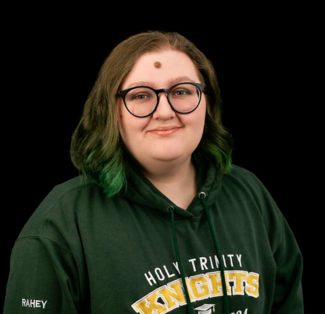
Essay Contest Winner in the First-Year Category for English 115, 2024-2025
Haley is in her second year of a Bachelor of Arts degree in Psychology. When she learned that she needed to take ENGL115 for her psychology degree, Haley chose Professor Neil Surkan’s 115 in particular due to its focus on the internet, a topic which impacts many aspects of contemporary human society and offers endless avenues of research. Indeed, while Haley was already interested in creative writing and literature in high school, this ENGL115 introduced her to the exciting avenues within research and academic writing, leading her to change her minor to English. In her award-winning ENGL115 essay, Haley elucidates the relationship between internet fan fiction and identify formation; she came to this innovative topic by combining her academic interest in psychology and research with her personal interests in online communities and fan fiction forums, places which offered her comfort throughout her adolescence. Indeed, as Haley says, “I probably would not be who I am today if I did not have access to safe online spaces!” In addition to reading fan fiction, Haley also finds time to read published fiction, but, like many of us, she struggles to name just one to read; instead, she prefers to recommend texts which are versatile, able to be perceived in many ways by many readers. Among those, she recommends The Great Gatsby by F. Scott Fitzgerald and 1984, by George Orwell, both of which, she says, are immediately relevant to our contemporary society. For future English students, Haley suggests making a variety of connections – to the text, to yourself, and to your professor: “It is very important to understand and connect not only to what you are writing, but to the texts you are studying as well. Making frequent annotations and quick connections to the texts you are studying helps to develop unique and personal thoughts about a text, which will motivate you to do well on your assignments and essays. Also, asking questions about the text you are studying or an assignment is definitely okay and will help you more than looking up an answer or just guessing!”
2023-24
Wayne Chang
Essay Contest Winner in the First-Year Category for English 115, 2023-2024
Wayne Chang is studying part-time toward a degree in Creative Writing and took ENGL 115 as part of the requirement for completing that program. However, he also thinks that English and literary studies are valuable strings to his critical and creative bow, beyond providing credits for a post-secondary qualification. English classes are obviously a good fit with creative writing, since in order to write well it helps to be well-read. At the same time studying and writing about literature enables you to broaden your perspective and cultivate empathy, while it also inculcates critical-thinking skills that help in understanding and analyzing the broader world. One way in which Wayne’s work in ENGL 115 helped in this intellectual process was by providing space for him to think critically about the effects of emergent generative-AI on art, artists, and creativity in general. In his award-winning essay for that course, Wayne delved into this pressing subject more deeply, clarifying his own thinking about AI’s profound implications for creative work (Wayne works full-time as an illustrator, so the benefits and risks of AI have personal and professional as well as societal scope for him). Beyond academia, Wayne is an avid fan of sci-fi and horror, genres he finds both entertaining and thought-provoking (he recommends checking out The Haunting of Hill House by Shirley Jackson, the short-story collection Exhalation by Ted Chiang, and Denis Villeneuve’s Blade Runner 2049). Finally, Wayne’s advice for future English students is to stay curious: “You never know where you might find a source of great inspiration. Even if a topic seems initially uninteresting, there’s almost always a way to find a personal connection to the topic. If you’re able to do so for every class, they will become infinitely more fascinating and easier to do well in.”
Eleanor Green
Essay Contest Winner in the First-Year Category for English 125, 2023-2024
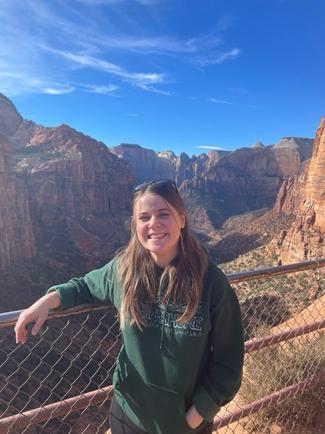
Despite continuing to pursue a Bachelor of Arts in Spanish, you won’t find a bigger advocate for English classes than Eleanor. Not only does she love them for exposing her to “different perspectives” on “various topics”—they inevitably help her to “develop well-rounded opinions” and express her views more clearly. One of the reasons for choosing Dr. Amelia Horsburgh’s section of English 115, for example, was because of this desire to look more broadly—in this case on the subject of food. “Food,” she writes, “is filled with deep cultural roots that provide us with the opportunity to learn and experience different cultures.”
In her award-winning essay, “Serving Inequality: Exploring Gender-based Disparities in Victoria James’s Wine Girl,” she explains that “While food and food cultures have many positive qualities, there are also important downsides, such as sexism in the service sector, that I believe are important for people to understand.” Sharing first hand experience of sexism, she felt responsible in the paper for continuing the work that Victoria James does. As Eleanor writes in her essay. “Through hard work, education, determination, and political activism, women are steadily creating not only a place to survive in the service industry, but a place to thrive.”
Just as she sees a future where sexism and harassment become less of the normal in the service industry, she appreciates other types of media that consider “the future of our world.” For example, her favourite book series is Eric Walters’s Rule of Three—in which the world must contend with the electrical and information grid going down in catastrophic proportions. Similarly, she loves the recent Netflix movie Don’t Look Up—a great allegorical parable about where we might be headed. Not all doom and gloom, however, she also admits to loving the comedy show Brooklyn Nine Nine.
Next year, Eleanor hopes to head to South America to develop her Spanish fluency and engross herself in cultures beyond Canada. As she says, in her advice to current and future students, “There’s no better learning opportunity then getting to share your ideas, listen to others, and develop new opinions with your peers.” No doubt seeking that opportunity in other countries and other tongues only increases the benefit. We wish her the best moving forward!
Taryn Pinder
Essay Contest Winner in the Second-Year Category, 2023-2024
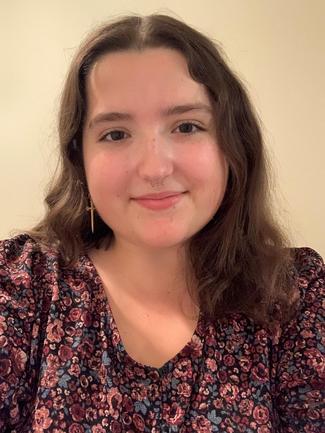
Taryn Pinder is a third-year student majoring in English and minoring in Studies of Women and Gender (SWAG) and Indigenous Studies. Since a young age, Taryn has used reading as a way to learn about the world and a form of escapism; she was “drawn into the magic and wisdom reading can provide.” So, picking English as a major seemed like a natural choice. Once in the English Department, she immediately responded to Prof. Sarah Crover’s 200-level seminar on villains and heroes, how these roles have changed over time, and the ambiguity that can arise with certain “heroes,” leading to Taryn’s prize-winning essay on the role of trickster figures in two works of contemporary fiction. Reading the seminar novels, Taryn found herself thinking that “while Coyote and Lyra [the two protagonists] may use their trickster abilities differently, they both use the act of storytelling to undermine suppressive powers. Each character, in their own way, reminded me that I am not as stuck within my narrative as a may feel, and maybe all I need to do is change the story.” Other works of fiction that have captured Taryn’s attention lately include Station Eleven (a TV show and a novel, by Emily St John Mandel), for a dose of the post-apocalypse mixed with Shakespeare, as well as Psalm for the Wild-Built by Becky Chambers and the epic (read: lengthy, but worth it!) fantasy, The Priory of the Orange Tree. To new students, Taryn suggests writing about “something you enjoy, [because] it truly comes across in your writing. Try to find passion in your topic and your essay with come easily. If you’re feeling stuck, don’t be afraid to sit down with your professor. They often have advice and can provide support when things feel overwhelming. Sarah was always there to guide me, and this essay wouldn’t be what it is without her.”
2022-23
Gabriel Young
Essay Contest Winner in the First Year, ENGL 125 Category, 2022-2023
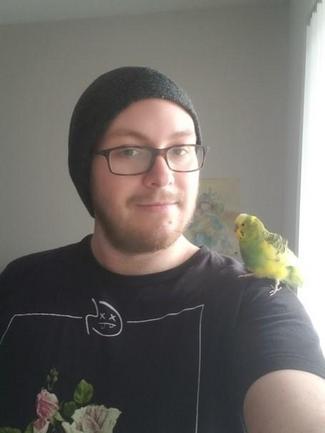
Gabriel Young is entering his second year of English courses. Reading and writing are two of his greatest interests, perhaps because Gabriel finds it “fascinating to look at just how much literature reflects and impacts human cultures.” While he is most drawn to literature and creative writing, Gabriel is also very interested in the zoology and paleontology, and enjoys getting out and enjoying the natural world.
The class that led to his award-winning essay -- ENGL 125: Topics in Literature, with Professor Bryn Skibo – might have been tailor made for his interests. It provided Gabriel an opportunity to explore where the lines between human and animal, nature and culture, cross and blur. In his essay, “Hybridity and Performativity: Different Approaches on Human Nature Through Human-Animal Hybrids in Science Fiction,” he explores what it means to be human in The Island of Doctor Moreau, by H.G. Wells, and Nathan Adler’s “Abacus.” An avid reader of Sci-fi, Gabriel found “Nathan Adler's approach to the topic, as … an Indigenous and queer author,” most intriguing. While noting their profoundly different approaches to the question, he argues that both texts conclude that “humanity is ultimately performative.” His essay is a careful examination of how humans use perceptions of the Other to help construct and perform a sense of self.
Gabriel’s top three recommendations, for their “layered, clever, and unique” stories, are Jurassic Park (1993), Nope (2022), and Severance (2022). His advice for fellow students looking for a successful and humane semester? “Read ahead, think about what your text is telling you both explicitly and implicitly, and most importantly, take care of yourself. It's easy to get burnt out over the semester, and I find that pacing yourself and putting importance on your mental health goes a long way.”
Olive Andrews
Essay Contest Winner in the First Year, ENGL 135/FILM Category, 2022-2023

Olive Andrews is an upper-level student in English at VIU who plans to graduate from the program after three more semesters. She was initially drawn to English as a discipline because of her “life-long love of reading” and has found that studying literature in an academic context has only enhanced her engagement with it: “the more I learn about how to critically analyze what I read, the more I get out of it. Plus, I have a lot of feelings and opinions about what I read, and it's very rewarding to have a space in which to argue those opinions, and to learn how to defend them.” For Olive, criticism and enjoyment ultimately go hand-in-hand: she says, “If I didn't know how to enjoy a text and be critical of it at the same time, there wouldn't be anything left to enjoy!”
This desire to both enjoy and critically engage with texts has also led Olive to take film studies courses at VIU. Her interest in film analysis stems, in part, from having watched video essayists on YouTube dissect the films they love to understand what makes them great, as well as why and how they work to create an emotional reaction in audiences. In her award-winning FILM 101 essay, “‘He Covets’: The Unspoken Language of Gender in The Silence of the Lambs,” Olive sought to understand precisely what she found both enthralling and challenging about Jonathan Demme’s 1991 thriller—namely, the complexity of the relationship between Dr. Hannibal Lecter and Clarice Starling.
Noting that it’s difficult to recommend texts that everyone should read or watch, Olive has recently enjoyed the semi-autobiographical novel A Tree Grows In Brooklyn (1943) by Betty Smith, and John Green’s book of essays The Anthropocene Reviewed (2021), which is also available as a podcast. She finds the latter collection especially timely for thinking about “what humans can and should do with our time on Earth.” Although she acknowledges that finding time is not always easy during a busy semester, Olive’s advice to current and future English students is “to keep reading in your free time - and writing, if that's something you enjoy.”
Katie Carroll
Essay Contest Winner in the Second-Year Category, Best Essay, 2022-2023

Now in her fourth and final year, Katie Carroll has taken a circuitous but not unusual path to her Bachelor of Arts in English. Despite loving reading and writing from the earliest of days, she was originally only an English minor. Hoping to become a high school English teacher, she started in the Bachelor of Education program. But, after a couple of years she made the switch and eventually entered the Honours program.
In the Spring of 2023, she took Dr. Paul Watkins’s FILM 220. As she notes: “I really enjoyed getting to learn more about the history and technicality of cinema and to analyze film in a more academic way rather than just watching it for pure entertainment.” She encourages everyone to take the course for no better reason than to deepen our appreciation for what we seem to consume on a daily basis.
In describing her approach to her award-winning essay, “Out-of-Field”: Cinematography of the Unseen in Portrait of a Lady on Fire and In the Mood for Love,” Katie describes an “aha” moment. She began only with an adoration of the films and a desire to write about them. Trusting her instincts, she discovered her argument through reading, research, and reflection. Both films she argues deepen meaning by capitalizing on what’s literally happening out of the field of the audience’s vision.
No doubt this appreciation for film theory informs her love of adaptations of classics like Pride and Prejudice, The Princess Bride, and The Lord of the Rings. While she loves the books themselves too, she understands how movies are also texts—open to the imaginative and analytical skills honed during her time at VIU. While she expresses some ambivalence about finishing her degree, she ultimately feels “lucky to have worked with so many amazing professors and fellow students.”
In a last bit of advice to her fellow English majors, she offers this secret: “Use the library! Not just the online database, but the physical books!” In addition to saving money and finding interesting sources, it’s simply “nice to have a break from reading everything on the computer!”
Winslow Baril
Essay Contest Winner in the in the Second-Year Category, Innovation Award, 2022-2023

In his path to a Bachelor of Arts in English, Winslow Baril offers wise and valuable lessons about his “non-conventional approach” to this pursuit. While completing his coursework, Winslow describes a mindful set of tenets: “[L]earning without fear, allowing myself harmless comforts, and having compassion and understanding for the things that I feel.” This personal investment certainly informs his award winning project: “The Act of Creation: An Exploration of Transgender Possibilities in Paradise Lost Through Pottery.”
The project—focused on the production of a handmade vase, painted with transgendered reimaginations of Adam and Eve and accompanied by an amalgam of Bible verses—allows Winslow to engage with the long poem in ways that exceed textual, as well as conventional, interpretation. Winslow describes rethinking “the supposedly purest and most perfect of God’s creations, and showing how they relate to me and my transgender experience.” This rethinking is also a component of a more general approach to literature and art. Winslow enjoys “deep-diving into all sorts of media,” particularly in the form character studies, as shown in his recasting of Adam and Eve from Milton’s poem.
Winslow’s vase and essay were the final project for Dr. Sarah Crover’s Topics in Renaissance Literature. “It was my first class with Sarah,” Winslow notes, “and she was one of the key components in my enjoyment of the class, though my classmates and the subject matter were also incredible.” While relatively unfamiliar with the period, Winslow did not shy away. Feeling supported and encouraged, he embraced expanding intellectual boundaries along with filling in gaps.
Not surprisingly then, Winslow recommends an eclectic mix of texts—from a classic like Frankenstein, to a cult classic like Star Trek: The Next Generation, and a unique adaptation like Natasha, Pierre and the Great Comet of 1812. Each of these resonate personally as part of a larger effort to “honour all of my selves” Winslow notes, from the “five-year-old trapped inside of a twelve-year-old” to the “sixteen-year-old trapped inside of a twenty-five-year-old.” In kind, Winslow extends that same message to us all: “Do your past selves proud” and find what brings you inspiration and meaning.
Luci Edwards
Essay Contest Winner in the Upper-level Category, Best Essay, 2022-2023

According to Luci Edwards, winner of the essay prize for the Upper-level category, one of the contributing factors in discovering their “greatest passion” was the realization that, in English, “Your professors want to know what material you connect with most, and why.” Feeling encouraged to explore their interest in speculative fiction, but in horror more particularly, they enrolled in Dr. Paul Watkins’s English 330 course on Speculative Narrative. There they wrote their award winning essay—“Monstrous Pregnancy, Queer Bodies, and Male Anxiety: ‘Bloodchild’ and Other Pregnant Men of Speculative Horror”—an essay their instructor has described as “engaging, thoroughly researched, and thoughtfully contextualized.”
“Horror,” Luci writes, “has always captivated my imagination, whether it’s the written word or on the screen. I have long found the trope of body horror especially fascinating, as it seems counterintuitive that humans should want to consume such distressing media. The Gothic genre and modern horror have consistently served as meditations on our deepest traumas and most intimate anxieties, and I believe they are pieces worth a great deal more study and credibility than they are typically afforded.”
Now in their fourth and final year of an English Honours degree, Luci admits to a lifelong fascination with stories and early love for Greek mythology. As their essay indicates, in fact, the male pregnancy trope in fiction likely begins with Zeus giving birth to Athena out of his head. Both the historical breadth and thematic nature of their essay demonstrate their thinking of “stories as though they were time capsules, expressing the anxieties and ideals of the times they were made.”
In addition to having developed a traditional foundation throughout their treasured time at VIU, Luci has three more contemporary texts to share that everyone should give a try: the Graphic Novel series Bone by Jeff Smith, the television show Bojack Horseman by Raphael Bob-Waksberg, and the film American Psycho by Mary Harron. Having such a diversity of interests (including the love of frogs) has no doubt contributed to their success, as has their understanding that what matters at VIU is the “fluid exchange of ideas.”
2021-22
Samuel Hoffe
Essay Contest Winner in the First-Year Category for English 115, 2021-2022

In the Fall of 2021, Samuel was enrolled in Liam Young’s English 115 class because he believed that he could “use a refresher in academic writing.” In many ways, Samuel is grateful that he did. Not only was it a worthwhile course, but he also won an award for his essay, “Agrarian Contrarian: The Fate of Native Grasslands in an Age of Agricultural Reckoning.” Unlike the “dry, esoteric, inaccessible and not properly contextualized” texts so often peddled in English courses (beyond VIU, obviously), those in Liam Young’s English 115 class engaged Samuel deeply. Primarily, the complex and ongoing conversations about the politics and ethics of “food” around the globe inspired his essay.
In the essay, Samuel begins by sharing some observations about his time spent in Grasslands National Park in the summer of 2021. The essay goes on to “highlight the fact that native grasslands are one of our most critically endangered ecosystems in Canada and we only have an infinitesimal fraction of them remaining.” Inevitably, this loss—due in large part to a complex interplay between colonialist practices and the industrial agricultural food system—requires not only our immediate attention, but our solutions, some of which the essay explores.
In an interesting twist of fate, Samuel shares that being in Grasslands was quite literally an accident (a fact he doesn’t share in the essay). He had already accepted a position doing fieldwork in Alberta, but due to a skiing accident he couldn’t pursue the position. He went to Saskatchewan with his father instead and reports that “visiting Grasslands was especially poignant for me because when I visited, I too [like the Grasslands themselves] was quite very fragile and still healing.”
Before pursuing his interest in natural resource management, he completed a Bachelor of Design in photography at the Alberta University of the Arts and you can find his work here.
Currently, he is finishing his Resource Management Officer Technology diploma at VIU, and so suggests a couple of related and inspired texts among his list of favourites. He recommends Mary Oliver’s Devotions and Sigurd F. Olson’s The Singing Wilderness. More broadly, he is a major fan of Taylor Sheridan’s American Frontier Trilogy (Sicario, Hell or High Water, and Wind River).
In a good bout of advice to all students, but perhaps English ones in particular, Samuel advocates for personal investment in one’s subject matter. Not only does this investment make research more enjoyable, but it also makes one more open to change as “your research and as your writing take shape.”
As Samuel eloquently puts it, “Learning how to communicate in not just a concise, grammatically correct way, but an innovative and captivating one – finding a way to say something that truly conveys an idea – is an impressive feat.”
Rachel Davidson
Essay Contest Winner in the First-Year Category for English 125, 2021-22

Rachel is entering her second year of a BA in Geography, with a minor in Environmental Science. English was her favourite subject in high school, so she looked forward to fulfilling her English degree requirements, because she believes in the importance of telling and listening to stories.
The class that led to her award-winning essay -- ENGL 125: Topics in Literature with Professor Nicole Klan – provided her a renewed opportunity to explore how a story can “have a huge impact on someone.” She was troubled by the way the play, The Shape of a Girl, characterized the main female bully character as though her interest in boys and sex was marker of her deviance. When Rachel began researching bad girl stereotypes for her essay, “Perpetuating Bad Girl Stereotypes in “The Shape of a Girl,” Canadian Media, and its Effect on Girl Bullying Discourses in Schools,” she was “shocked” by its pervasiveness, and found herself realizing that these very stereotypes were “foundational” in discussions about girl bullying in her own school experiences. Her essay is a careful examination of the negative impact such framing of female bullying can have on young girls.
Three things she thinks anyone trying to find their way should turn to are the books The Hitchhikers Guide to the Galaxy, The Alchemist, and the music from Meatloaf’s albums Bat out of Hell I & II. Her advice for fellow students looking to succeed and still enjoy themselves? “Don’t be afraid to think outside of the box. Take advantage of general essay prompts to find a topic that really interests you and that you care about.”
Maria Driesen
Essay Contest Winner in the First-Year Category for English 135, 2021-2022
Maria Driesen is pursuing a degree in Child and Youth Care here at VIU, and although she claims that she “won this award on a whim”, she does acknowledge that it was her strong passion and interest in the experiences of others, specifically transgender people, that drove her to write this essay and consider in depth how trans peoples’ experiences are represented in literature.
Maria’s winning essay, “Holistic Representation in Casey Plett’s ‘Hazel and Christopher,” was inspired by Maria’s sense that trans people are not justly represented. She spent a lot of time thinking about the spaces that trans people occupy and her essay impressed Professor Mike Roberson who describes Maria’s work on this text as “showing great initiative and sensitivity” as well as “finesse.”
When asked what advice she can give to other students, Maria says that it’s really important to write essays on topics that you’re truly interested in because “You’re not going to write a good essay if you don’t care about the topic”. You don’t have to be a “scholarly genius” to write a good essay, she says, “just a really passionate regular student”, which is how she sees herself.
Her ongoing love of reading and some recent positive experiences in the English courses she was required to take for her program have sparked her recent interest in literature, but she has always enjoyed reading for pleasure. Some of her all-time favourite books are Looking for Alaska by John Green, To Kill a Mockingbird by Harper Lee, and The Carry On series by Rainbow Rowell.
Patrick Dunlop
Essay Contest Winner in the Upper-level Category, 2021-2022

For Patrick Dunlop, fourth year English major, literature represents both an “escape hatch” as well as a “grounding mechanism.” In other words, literature is “transportive”—offering a place to at once feel at home and depart from that home in exploration of different periods and different worlds. One of those worlds—Medieval Europe—drew him with “an immediacy and an intensity that was impossible to ignore.” So much so that his essay for Dr. Sarah Crover’s English 340 class garnered him an essay award. In “Medieval Female Mystics: Superfoods, Sickness, Subversion, and Sainthood in Hildegard von Bingen and Christina the Astonishing,” Patrick offers a riveting comparison of the two mystics, ultimately characterizing them as “proto-celebrity influencers.”
As Patrick writes of these mystics, they were “simply magnetic figures whose undeniable celebrity and influence transcend all barriers of time and space.” As he continues, “[I]n a time period often characterized as dim and regressive,” here are two women bold enough to risk everything in the name of their faith, even “accusations of witchcraft, demonic possession, or outright heresy.” Ultimately, being surprised by the “colourful and varied writing” he discovered about this time period, Patrick felt inspired to “showcase these powerful, free-thinking women.”
While he may have enjoyed the escape to Medieval Europe, Patrick is also at home with classics like Tolkien's The Hobbit, The Simpsons (first 10 seasons only), and Orwell's 1984. And, when he’s not re-reading or re-watching you might him in the kitchen or on the beach because he loves cooking and taking beach walks. Too, if you see him around his year, ask him about his favourite single malt scotch.
As he finishes up his last year of his BA, Patrick imparts to all future and present English majors that they should love the Oxford comma, but also the following advice: “Do the reading. Show up to class. Finish your work.”
Kassandra Robicheau
Essay Contest Winner in the Upper-level Category, 2021-2022
Has completed her BA (Honours) in English at VIU and has begun the MA programme at Dalhousie University. She has always loved reading and writing, but she finds literary analysis “fascinating,” noting, “uncovering meaning, then mucking through it all to pull together threads and create an argument… is so rewarding.”
She was drawn to Dr. Cynthea Masson’s course on the Black Mirror series -- ENGL 394: Topics in Television Narrative -- because it offered her the opportunity to “apply techniques for studying texts with audiovisual components” while also providing “easy contact points for applying more traditional literary analysis and theory.” It was this course that led to her award-winning essay, “Invisible yet Omnipresent: The Future of Disability as Reflected in Black Mirror.” Kassandra found her interest in disability theory growing since she first started to consider herself a part of the disabled community. While watching Black Mirror episodes; she “noticed a trend of disability being skirted around, rarely acknowledged, often erased, and yet present as a looming threat.” Ultimately, as she argues in her essay, “how disability is treated is not just a minority concern (which wouldn’t negate its importance), but it affects us all.”
If she had to recommend three texts to fellow students, Kassandra would choose NK Jemisin’s The Broken Earth trilogy: “the writing is incredible, the narrative is entertaining, and it beautifully handles complex issues and feelings.” When not pursuing her own studies, Kassandra works as a tutor through the volunteer tutor program at VIU, something she encourages peers to consider making time for as well.
Her advice to fellow students is simple: “Trust in yourself while being open to imperfection.” Kassandra notes that this knowledge was an important part of her evolution as a student. Risking speaking up to add a perspective that she feared was “too obvious” often turned out to be rewarding, while growing comfortable with uncertainty helped her to treat speaking in class or interpreting a text as a “first draft” that might need some revising: “There shouldn’t be any shame in acknowledging that you aren’t entirely sure about something or leaving a gap to fill in later.”
2020-21
Emma Newton
Essay Contest Winner in the Second-Year Category, 2020-2021
Emma Newton is a history major going into her third year at VIU, but having always loved reading and writing, she feels that the English classes she's taken have provided her with an important creative outlet. Her award-winning essay for Professor Sarah Crover's class on "Ancients and Moderns" enabled her to explore the intersection of her major with English studies, bringing ancient history together with myth, legend, and classical literature.
Why witches, though? Emma says she's always been fascinated by them, considered both as literal figures and as symbolic of the values of society - particularly in relation to gender roles. Also, given the topic of Prof. Crover's class - non-traditional heroes and villains - it made sense to examine the disjuncts between the way witches have been treated historically and how more contemporary depictions have tended to show them. As Emma puts it, "so many of the witches I grew up reading about were presented as heroic characters, which is such a stark contrast to the historic treatment of witches and other marginalized women."
A larger motivating factor for Emma to research and write about this topic was the representation of women more generally. Says Emma, "it's so important to discuss women’s representation in mass media, in order to continue a positive movement towards characters ... little girls can look up to." Emma herself says she's fortunate to have grown up reading and watching texts that feature strong, complex female characters - like the titular character (played by Sarah Michelle Gellar) of the popular TV series Buffy the Vampire Slayer. Buffy also speaks to Emma's love of texts that feature fantasy and magic, with two of her favourite novels being Neil Gaiman's American Gods and Naomi Novik's Uprooted.
Emma's advice for current and future English students is to follow your passion - particularly when it comes to writing. The essay-writing process, she says, goes so much more smoothly when you write about something you love. And since most profs want to see their students succeed, Emma suggests finding some area of personal interest that fits in with the course outline.
Bethany Freed
Essay Contest Winner in the Third-Year Category, 2020-2021
Bethany Freed is completing her BA in English with a minor in History at VIU. This is her second foray into post-secondary education: she also attended Randolph Academy of the Performing Arts, completing a training program in acting, singing, and dancing. While she still loves performing, Bethany notes, “theatre school primarily deepened my love of the written word rather than performance.” When she decided to continue her education, this love made the choice to major in English a natural progression.
She was drawn to the class that led to her award-winning essay – ENGL 314: Modern Critical Theory with Professor Melissa Stephens – because she plans to pursue an MA in the future. Bethany felt it was important to familiarize herself with a broad range of critical theory to strengthen her skills in literary analysis.
As someone who has experienced chronic/hidden illness all her life, Bethany explains that her essay, “Aesthetic Disqualification, Narrative Imagination, and Gender Bias in Endometriosis Experiences,” was “definitely a passion project.” She believes “that having honest conversations about the biased and often substandard care women—and especially Women of Colour—experience when seeking medical care is crucial. While endometriosis experiences only encompass one niche example of women’s experiences in the medical world, writing this essay allowed me to contribute to this important conversation.”
Three books she believes everyone should read are Monkey Beach by Eden Robinson, The Promise by Pnina Bat Zvi & Margie Wolfe, and I Know Why the Caged Bird Sings by Maya Angelou. Her advice for future students? “Audio books are your friend! Depending on the reading I will have a hard copy and an audiobook so that I can make notes in my hard copy, but I have the ability to read while doing chores, commuting, or even going for a run.”
When she’s not working on her studies, you can find Bethany experimenting with makeup art.
Hailey Futer
Essay Contest Winner in the First-Year Category, 2020-2021
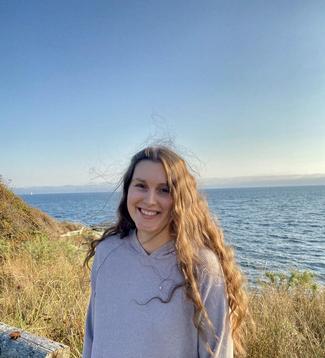
Hailey Futer is a VIU Education student who has loved writing and the possibilities of self-expression ever since she was a child, but it is only in the last year that she has come to experience writing as a means of healing and empowerment. She was initially nervous to write for her English courses and thought that writing about topics that were chosen for her would be too limiting, but she has found that she can bring her own voice into whatever she subject is assigned and that her experiences are relevant to others and important. “I can come up with unique ways to make my assignments my own,” says Hailey.
Her winning essay, “'All in the Head': Using Storytelling to Help Patients Who Suffer from Mental Illness and Break the Stigma,” was born out of her own experience of recovery from two major unsuccessful surgeries and her struggle of whether or not to sue her surgeon, and is, as Professor Sandra Hagan describes, “an incontestable case for the power of storytelling to heal mental illness… [and] an innovative and sophisticated approach to an important topic for everyone, but especially for young adults in our current challenging times.”
When asked what drew Hailey to her topic, she says that after two years of keeping her suffering a secret out of fear of how others would view her she had the chance to explore her experience of trauma in an essay in an English 115 class. That experience of writing and sharing with the class, and her experience of witnessing a friend’s battle with mental illness and their choice to speak about it at a live storytelling event, have prompted her sense that writing and sharing one’s suffering is essential for healing. “By sharing my essay and my suffering with others, I discovered that I am not alone, and I felt like all this weight I had been carrying around for so long had been lifted,” Hailey reflects. “I decided to write about writing as a form of therapy because of how it make me feel and how much it helped me heal and move on.”
Given her recent positive experiences with writing, Hailey is considering a degree in English, but she also notes that writing is hard work and “the most difficult part of writing essays that are of great importance to [her] is knowing when to be finished.” She recommends taking breaks and says that after hours of staring at the page, the words might come to her late, even during a workout.
Hailey was hesitant to recommend books or movies, admitting that she doesn’t like to feel responsible if people do not enjoy them. However, she did suggest a few current favourites: The After series by Anna Todd, Grey’s Anatomy, and All the Light We Cannot See by Anthony Doerr.
Julia Coltman
Essay Contest Winner in the Third-Year Category, 2020-2021
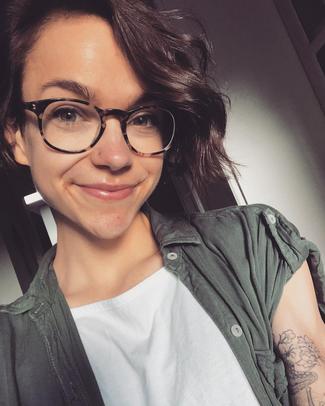
If you take the opportunity to read Julia’s award-winning essay you’ll be surprised to discover that when she started her degree she wasn't planning on going into English at all. While she’s always loved reading and writing, she realized after delving into the program there's a lot more to studying English than what some high school classes make it out to be. For example, she mentions that one of her favourite aspects to studying English includes seeing how the canon evolves in real time. She appreciates how “the voices and stories and the people behind them previously ignored or silenced are being lifted up and finally heard and given the recognition and attention they have always deserved. Having those stories heard is so important in our study of culture, not only to understand the past but to see the way it influences us today and where it leads us.”
She wrote her paper on Mary Sidney's translations of the Psalms for Sarah Crover’s Renaissance Lit class—a class that she really enjoyed because it introduced her to an entire other side of literature that she confesses she would have normally “steered clear of otherwise.” Luckily, however, the class allowed a further investigation into her growing interest in the intersection of women’s experience and female agency. Still, Julia definitely appreciates challenges and embraces the increase to her breadth of knowledge about literature. Her motto and advice to other students stems from such an attitude. She advises “to have an open mind about what you will read. There will always be works that are not your cup of tea, and that is okay, but have an open mind and if you have thoughts on a work, even if you think they're messy and confused, make them heard. Profs are there to lead you through the confusion and try to help you get as much out of even the most difficult reads imaginable.”
In the same way that her Renaissance Lit class opened her eyes, so did Clay Armstrong’s 20th and 21st Century Lit course. There she discovered a collection of works by James Baldwin, the Civil Rights era activist and writer. She recommends in particular a couple of letters/essays bound up together in a book called The Fire Next Time, as well as a play called Blues for Mister Charlie, both of which deal with issues that “speak to our present just as clearly as they applied to the moment he was writing in.” Outside of academic reading, she also endorses Victoria Schwab, an adult fantasy writer, particularly Schwab’s Shades of London trilogy and the recently released The Invisible Life of Addie LaRue.
While in the Fall of 2021 she will be completing the fifth year of her degree, she frankly admits that she’s uncertain about what the future holds for her, but between her accomplishments and attitude, she will no doubt revel in that discovery.
Lachlann Glennie
Essay Contest Winner in the Third-Year Category for Innovation, 2020-2021
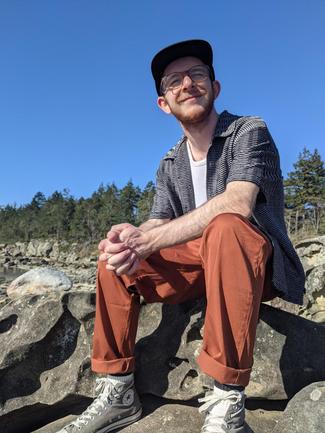
Lachlann Glennie recently completed his BA in English, with a minor in Languages and Culture. He was drawn to English studies because of the course work’s capacity to encourage personal growth: “I have developed the skills, compassion, and emotional depth to meaningfully engage with social issues. I have English to thank for that.”
Indeed, the class that led to his Lachlann's ward-winning essay -- ENGL 390: Topics in Word and Image with Professor Sandra Hagan -- provided an opportunity for Lachlann to explore his interest in multimodal literacy, where “images, sounds, and even tactile experiences” are included as part of the reading experience.
His essay, “Feminism, Tragedy, and Felt: Adapting Thomas Hardy’s Far From the Madding Crowd into a ‘Cozy Classic,’” brings together his storytelling and felting talents. While Lachlann freely admits that part of the driving force behind this choice was to “have a laugh” during COVID times, the work is also informed by his own interests in accessible education (he will be continuing on at VIU to pursue a post-bacc in Education). Applying the genre of the Cozy Classic – twelve-word adaptations of literary classics for children under the age of three – to Thomas Hardy’s feminist engagement with Victorian patriarchal structures in Far From the Madding Crowd, Lachlann created his own adaptation of Hardy’s novel, using images of beautifully felted characters to accompany his selected key words. While he feels that “visual elements, even in intensely academic contexts, can support and even strengthen the explorations of literature that take place in classrooms at all levels,” he notes that “a translation of [the novel’s complex] themes into physical materials is incredibly challenging.” [include clickable link to cozy classic?]
Lachlann encourages readers to engage with multimodal story-forms, recommending the novel Tokyo Ueno Station by Yu Miri, the video game GRIS by Nomad Studio, and the animated film Song of the Sea by Tomm Moore.
His advice for English students is “to always see the value in what you are studying. The world needs more people who see the value of a story and are willing to connect with narratives and perspectives that expand beyond their experience.”
2019-20
Margaret Kim
Essay Contest Winner in the ENGL 115 Category, 2019-2020

Margaret Kim enrolled in ENGL 115 because of a degree requirement. Her winning essay, “Seeing Myself Out: Dying by Choice over Affliction” is addressed to her parents, with whom she had not previously discussed the chronic pain she has suffered for years. Having been unable to express her feelings to them about a medical malpractice experience, Margaret decided that writing this essay would give her the ideal opportunity to forge a new dynamic. Indeed, as she explains, Margaret was able to use the essay as if it were “well-thought-out letter” to her parents.
Margaret enjoys reading Archie comics, Chicken Soup for the Soul, and dictionaries. She would advise other English students to meet with their profs who, in her words, “hold invaluable advice and can guide you where you need to go.” She hopes that other students will connect with her on LinkedIn.
Ella Roger
Essay Contest Winner in the Second-Year Category, 2019-2020
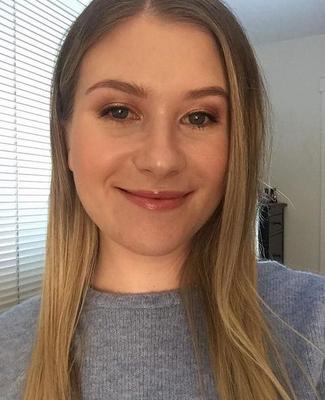
Ella Roger is going into the third year of a BA in Psychology at VIU and plans on becoming a therapist. However, English and literary expression remain close to her heart. She has loved reading and writing since she was a young child; encouraged by her English-teacher mother, with whom she bonded over reading, she was never without a book or two. This literary passion continued as Ella grew up, leading her to develop an ongoing interest in expressing herself through poetry, as well as, once at VIU, taking English classes as electives. English (and related disciplines such as film studies), says Ella, provide “a space where I can think freely and appreciate the work of others, while also enjoying the newfound knowledge and respect that I gain from listening to others’ ideas and views.”
Ella's award-winning essay “Rural Homophobia or Universality of Love? Brokeback Mountain in Literature and Film” was written for ENGL 233 with Professor Melissa Stephens. This course, which examines the relationship between literature and film, enabled Ella to explore how the techniques of cinematography create on-screen meaning, as well as to consider the complex process by which a short story like Annie Proulx's “Brokeback Mountain” is transformed into Ang Lee's cinematic adaptation. In particular, Ella was fascinated by Proulx's and Lee's respective depictions of love and sexuality, including how they are shown to be constrained by a rural, homophobic society. In a larger sense, studying and writing about 2SLGBTQ+ film and literature, especially when it “accurately depict queer experiences,” is crucial for Ella both because of her fundamental commitment to equality and in that such texts can ultimately “provid[e] a voice to those who so desperately need it.”
Two texts Ella particularly recommends reading are Gillian Flynn's novel Gone Girl, a clever, formally creative psychological thriller, and The Diary of Anne Frank. Ella says she particularly likes texts, such as The Diary, that enable you to form a deep connection with the protagonist and their struggles. As well as fiction and memoir, she also likes reading self-help books as a means of gaining greater understanding of herself and others.
As an award-winning essay writer, Ella has some helpful advice for budding English students. When it comes to paper-writing, you should recognize that it's a process and that coming up with and organizing your ideas inevitably takes time. An important correlate to this processual view is not being afraid to make mistakes in your writing - or even start again. This is something Ella herself had to do while writing her paper for ENGL 233, but she sees it as a crucial part of her ongoing development as a student and writer.
Aislinn Cottell
Essay Contest Winner in the Upper-Level Category, 2019-2020
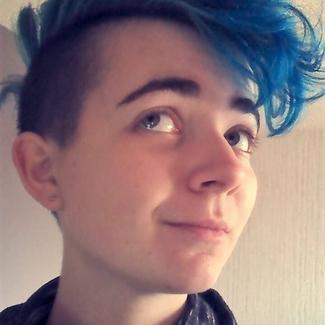
Can the study of literature result in you yourself becoming an accomplished author? Aislinn Cottell, a recent graduate of VIU, is the living proof. Having recently graduated with an Honours degree in Creative Writing, Aislinn found that English courses frequently “served as a catalyst and inspiration” for her own works of fiction. “I love literature and culture analysis,” she explains, “while my CREW major gave me my creative outlet and stretched my writing skills, I found English classes enriching for my social and cultural knowledge bank.”
As an environmental activist, Aislinn found Janet Grafton’s Children’s Literature course to be particularly engaging. “This course became very much environmentally focused, and the class had a lot of interesting discussions concerning how past ways of living could be used to help build a more sustainable society in the future.” For one of the course assignments, Aislinn wrote a remarkably lucid and original literary analysis. In it, she considered the themes and historical contexts of Louise Alcott’s Little Women and Astrid Lindgren’s Pippi Longstocking, making astute connections between these early children’s classics and an emerging but largely unrecognized motif in contemporary culture called solarpunk. “I was already familiar with the concept of solarpunk,” she writes, “and found it to be very relevant to the idea of constructively linking the past and future.”
So, what does Aislinn do when she’s not engaging in environmental activism, writing poetry or works of fiction, and spinning out award-winning English essays? Her favourite books and television series include Doctor Who, The Hitchhiker’s Guide to the Galaxy, and The Malazan: Book of the Fallen—all of which she wholeheartedly encourages others to appreciate. And for any aspiring authors out there who want to be inspired by English courses, Aislinn offers the following advice:
As someone who only started outlining their essays in the last year of their six-year degree—outline your essays. Surprisingly, it makes things quite a bit easier! Even if it’s only a couple of bullet points per paragraph, and you don’t touch it again until the night before it’s due—do a quick brainstorm and write something down ASAP after it’s been assigned. Your future self will thank you, every time.
Great advice from an exceptional writer whose future self will undoubtedly be grateful for her present accomplishments.
Lys Morton
Essay Contest Winner, Innovation Category, 2019-2020

Lys has just finished a degree in Creative Writing at VIU (Class of 2020) and sees English classes as having been an important part of this process, as they provided a way of building broader knowledge of the literary world. In particular, the class that led to Lys's award-winning essay—ENGL 221: North American Indigenous Literatures, with Professor Nelson Gray—provided a means of situating specifically First Nations stories in relation to the larger literary world. Indeed, Lys's piece, “The Marrow Thieves, Coming-To, and the Ownership of Queer Narratives,” itself has a broader aim; beyond being part of an essay marked in an English course, its argument also functions, Lys says, as “a way to start holding space for all the Coming-Out and Coming-To stories that have yet to be told.”
As well as urging us to read the novel by Cherie Dimaline that the essay focused on (2017's The Marrow Thieves), Lys also recommends two recent works of autobiographical non-fiction that look at contemporary masculinities: Man Alive: A True Story of Violence, Forgiveness and Becoming a Man by Thomas Page McBee, and All Boys Aren’t Blue by George M. Johnson.
As a recent graduate, Lys has some helpful advice for current and future students in English: “Breathe. Seriously. Release your shoulders, you’re going to be okay.” Lys also recommends taking classes “outside your wheelhouse.” You can read more of Lys's work at Lys Writes Now.
2018-19
Aleah Rockwell
Essay Contest Winner in the ENGL 125 / INTR 101 Category, 2018-2019

As a third-year student at VIU, Aleah Rockwell approaches her studies in the English department with a keen focus and with the levity that can only come from the confidence of someone who has learned the secret of writing first-rate essays. “If you're struggling with writing,” she counsels, “ it can be helpful to write out your thesis on a piece of paper and then erase it and rewrite it, and erase it, and then maybe throw it in the garbage, and then fish it out and rewrite it. From there, the rest of the paper is a piece of cake.” When it comes to the quality of the cake, however, there’s always the seemingly interminable revisions required. And with respect to these, Aleah is both humble and generous, being sure to acknowledge the assistance she has had from the VIU English faculty. “I’m eternally grateful to my English professors,” she says, “for putting up with my writing when I've done a poor job at proofreading, and I'm even more grateful for the amazing environment they create when it comes to discussing literature. I can honestly say it makes me enjoy English that much more.”
A self-professed “junkie” when it comes to “anything science fiction,” Aleah was excited to sign up for an interdisciplinary course, co-taught by Daniel Burgoyne and Doug Stetar, that focused on speculative fiction such as Margaret Atwood’s Oryx and Crake. It was her response to Atwood’s book that resulted in a highly original award-winning essay. “I was enthralled with Margaret Atwood’s dystopia,” she writes, “and initially had a very biconservative stance on the Crakers” (the genetically-altered humans portrayed in the novel). In the end, however—after re-writing that thesis one more time perhaps—she “decided to argue contrary to this knee jerk reaction,” and, in so doing, “was able to see the novel in a more nuanced way.”
Aleah’s ability to develop and convey a nuanced argument of this kind may also have resulted from the diversity of literary, television, and film sources that inform her ideas—sources that range from Alfred Camus’ L’Etranger to episodes of Black Mirror to the critically-acclaimed film Get Out by writer and director Jordan Peele. With an eclectic range of sources such as these and a positive attitude to life and learning, it is little wonder that she has emerged as one of VIU’s most accomplished English students.
Rane Love
Essay Contest Winner, Innovation Category, 2018-2019

Rane is one of those rare students who melds creativity with the ability to read deeply and draw meaning from literature, including from some of her favourites: Michael Newton’s Destiny of Souls, Paulo Coelho’s The Alchemist, and Richard Wagamese’s Embers. While studying English at VIU last spring, she seized on an opportunity to expand her knowledge of Canadian literature:
I was interested in publications within the last 5 years, and Paul Watkin’s course considered authors from a diversity of backgrounds: Indigenous, Japanese-Canadian, African-Canadian, and Trinidadian-Canadian. The 2SLGBTQ+ community and other minority groups in Canada were also discussed, and the many books we read brought to the fore systemic issues that run parallel through them.
In response to the ideas in ENGL 220, Rane created a mixed media work compelling enough to garner an innovation award from the English department.
Given the many different cultures and texts that we studied, I began brainstorming how I would bring these topics together to capture the many cultural faces of Canada and touch on both the light and dark aspects of our society. The mixed media work Mosaic Myth tells us we are a multicultural nation, yet we struggle to reconcile this ideal with the damages caused throughout the years. I wanted to focus on the texts we read and to pull out the many struggles the characters endured as well as their hopeful moments.
Rane speaks eloquently and insightfully about why English courses have been integral to her education: “I feel it is important for students to learn how to understand texts, form their own conclusions, and be able to articulate their thoughts and feelings clearly and confidently.” Even more impressive, however, is the way she overcame significant challenges to her education. Leaving an unhealthy family environment at fourteen and working to support herself left little time for studies. But later, with only a grade 8 education, she sailed through her university entry exam and is now a third-year student and well on her way to a BEd and a minor in Indigenous Studies. Need any more inspiration? Here is her advice to current and future VIU students:
Be kind to yourself. Remember to put your whole heart into everything you do, that is always something to be proud of—no matter what the outcome. Enjoy your time in the classroom and listen as if you will never hear those words again; it is a privilege denied to so many. When you feel stressed, take a few moments to breathe deeply and re-centre yourself—this too shall pass. Gratitude is the best attitude and remember that you hold the key to your future.
Armin Halbach
Essay Contest Winner in the ENGL 135 / FILM 101 Category, 2018-2019

Armin Halbach came to VIU from Germany in Fall 2018. Inspired in part by a desire to improve his English, he took advantage of one last opportunity to study abroad before finishing his Master’s Degree in Psychology, which he did in March 2019. As a devoted fan of movies, he jumped at the opportunity to take Film 101 with Dr. Paul Watkins. While he always reflected on the technical aspects of film, such as narrative, cinematography, and acting, he was excited to learn and apply the appropriate terms for what he so keenly observed. He confesses that the visual impact of Wes Anderson’s Grand Budapest Hotel made the film his all-time favourite. As well, he was amazed by both Mulholland Drive and In the Mood for Love—two films that he believes everyone should see because they are cinematic masterpieces. As a psychologist, he was especially interested in the way audiences engage changing points of view and how these have emotional impact. Those interests became the basis for his award-winning essay.
Concerning books, he recommends William Golding’s Lord of the Flies because of its cynical view of human nature and its shockingly current social relevance. Still, he admits to being more of an audiobook fan and professes a love for Agatha Christie. Just as he enjoys thinking about how films come together, he adores the thrill in solving a crime.
He believes in writing continuously to develop a consistent style of writing that enables a reader to dive more deeply into the thought process behind the writing. Currently, he is working on a film blog to inspire others to watch more movies and to reflect on their unique characteristics.
Chloe Wolanski
Essay Contest Winner in the Upper-Level Category, 2018-2019
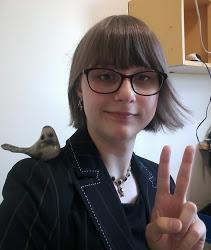
In Fall 2019, Chloe will enter her fourth year of the Bachelor of Arts degree (English major and French minor). Afterward, she plans to pursue a post-baccalaureate in Education with the goal of teaching secondary school here on Vancouver Island.
Chloe has always had a passion for both reading and writing fiction. She says that English courses became her favourites because they encouraged her to develop effective writing skills and habits. She particularly enjoys reading novels that she may not otherwise have encountered outside her courses. “When your homework for the week is to read a good book, do you really have homework at all?”
ENGL 480: Research Methods (the course in which she wrote her winning essay) was a prerequisite for the English Honours route. However, she heartily recommends it for anyone inclined to delve into new ways of reading academic texts. Regarding the course, Chloe explains, “I learned a great deal about academic analysis and became versed in many critical theories to which I had not previously been exposed. This skill set will surely impact my papers next year.”
Chloe contends that one of university’s most important qualities is the way it pushes students to critically examine their own biases. “Until recently,” says Chloe, “I subscribed to a fairly utilitarian viewpoint without really considering the implications of the theory. It was by writing my ENGL 480 essay that I sought to analyze both the world at large and myself on a personal level in order to find a more accurate understanding of, and approach to, equality.”
Chloe attributes her love of science fiction and fantasy to works such as Douglas Adams’s The Hitchhiker’s Guide to the Galaxy, Brian Jacques’s Redwall series, and J.R.R. Tolkien’s Lord of the Rings. At age eleven, while on vacation in Mexico, Chloe was introduced to Tolkien via The Hobbit, which she discovered on a small hotel bookstand. “But if I had to recommend a few books that would be broadly enjoyed,” claims Chloe, “I would have to suggest Richard Dawkins’s Unweaving the Rainbow for its scientific beauty and Vladimir Nabokov’s Lolita for its enchanting prose and masterful characters. Then I would sit everyone down with The Hitchhiker’s Guide to the Galaxy for a good laugh—because life means very little without a bit of humour sprinkled in.”
“The best advice I could provide to English students,” says Chloe, “would be not only to read but, specifically, to read broadly. Many of my best essay concepts have sprung from conversation between my English courses and other unrelated subjects, such as Sociology, Anthropology, Psychology, and even, ironically, French. Any piece of knowledge, however seemingly irrelevant, that can be tucked away in one’s brain is just waiting to spring free at the perfect moment. So read, read, read, and stockpile every new concept and theory that you can so that when you do find yourself stuck on that next late-night, nearly-due research essay, you have some other basis of knowledge off of which to bounce your ideas.”
Julie Coltman
Essay Contest Winner in the Second-Year Category, 2018-2019
Julia Coltman is a VIU English major who has always loved reading and dreams of one day opening an independent bookstore. She was, however, a bit nervous when she realized that her English course in pop culture would focus on espionage fiction, a genre that was new to her and about which she is, admittedly, still “iffy.” Despite her initial hesitancy, however, Julia’s winning essay is a thoughtful and perceptive analysis of power, knowledge, and surveillance in Dave Eggers’ The Circle, and, as Professor Sandra Hagan describes, “a compelling case about the hunger for transparency in our ‘media-saturated’ world.”
When asked what drew her to the topic of her award-winning essay, Julia acknowledges the relevance and currency of its themes, pointing out that the inevitability of surveillance from tech and human idolization of tech is problematic. “I hate to sound old-timey and paranoid about it, because I can’t deny that certain elements of surveillance and those advanced technologies are convenient, and, for lack of better word, just plain cool.There should be a limit, though, and the point where it starts to create more problems, which are then solved by even more developments in tech—that’s where I feel we start to run ourselves into some trouble,” reflects Julia.
Now entering her third year of English at VIU, Julia describes her student experience as positive, attesting to the variety of diverse works she has been able to read, noting that analyzing literature has not taken away her joy of reading but that sharing the experience with students and different professors has “served to make reading even more beautiful and interesting.” She particularly values the freedom in her classes to engage with and critique all works of literature, observing the flaws and injustices of works that are deemed historically important and valuable.
When asked for her favourite book, Julia resists being pinned down. Writers such as Elie Wiesel (Open Heart) and Richard Wagamese (Indian Horse) inspire her for the way their books hold onto “kindness and love and belief in the good of humanity” despite the horrible things to which they attest. She also loves V.E. Schawb’s books and puts them at the top of her list, observing that “a mix of fantasy, royal politics, magic, parallel worlds and traveling between them, and morally ambiguous protagonists will always win [her] heart.”
Despite her success in English studies so far, it hasn’t been entirely easy for Julia to find her voice in class or to believe that her ideas are worth contributing. Acknowledging that this is something she will continue to work on in the next few years, Julia encourages other students to do the same: “Putting your ideas out there is also the best way to find like-minded humans and to make fast friends.” And, while literary analysis, intriguing class conversation, and personal joy of reading feed her soul and definitely sustain her personal and academic life, Julia claims that what’s often needed for “crunch-time stress relief” during the semester is to indulge in the Netflix baking competition Nailed It, which features contestants who are “at best amateurs and at worst completely clueless in the kitchen” and is “the best kind of ridiculous.”
2017-18
Ashley Thorup
Essay Contest Winner, Second-Year Category, 2017-2018

At times during her schooling, Ashley Thorup felt hemmed in by some of the subjects she had to take. Much of what she was learning appeared at times to be frustratingly black-and-white, overly premised on rigid “right-or-wrong principles” or “absolute laws.” However, English felt different somehow. “Literature,” Ashley says, initiated an enticing encounter with “a multiplicity of voices and perspectives” and thus raised the broader possibility of “an escape from the rigidity of society.” Having graduated with an Honours degree in English from VIU in June 2018, Ashley will be continuing her exploration of the possibilities of literature when she begins her Masters at McGill University this fall.
Ashley’s award-winning essay was written for ENGL 233, a course on the interrelationship between classic American novels and their contemporary film adaptations. In exploring James Franco’s recent cinematic translations of two important Modernist texts, Ashley was able to bring together two of her particular passions in English: the fiction of William Faulkner and the intersection of film and literature. Faulkner’s iconoclastic and influential narrative experimentations and thematic preoccupations—as Ashley puts it, “fractured narrative styles” and an abiding concern with the “subjects of race, mental illness, and [the] departure from tradition”—are by now well known. Ashley’s unique intervention here has been to connect Faulkner’s “playful” literary form with Franco’s directorial style, thus suggesting that the relationship of original text to modern adaptation is not merely one of change but also one of continuity.
As someone who has successfully navigated the path of an English major at VIU, Ashley has some words of advice for aspiring literary scholars: “Find something that you are passionate about and read everything around it” (this includes exploring related texts in “other art forms[,] such as music, visual art, and film”). Overall, though, Ashley thinks that studying in the arts and humanities is not merely a source of personal fulfilment. Rather, it provides an important perspective on broader societal issues, including questions of tolerance and human rights. Perhaps unsurprisingly, when asked for reading recommendations, Ashley’s suggested Faulkner’s The Sound and the Fury, Allen Ginsberg’s “Howl,” and Tony Kushner’s Angels in America—three texts that combine audacious formal complexity and experimentation with a profound concern with important social and political issues at different moments in 20th-century American history.
Georgina Wood
Essay Contest Winner, Innovation Category, 2017-2018

Georgina has just finished her Bachelor of Arts (with a Visual Arts major and an English minor). She will be continuing her studies to attain a Bachelor of Education. View her essay and illustrations.
Notably, Georgina was drawn to English classes because English had traditionally been her weakest subject—one with which she had often struggled. For Georgina, an English minor was an important personal accomplishment. She considers the achievement of a university degree evidence that now inspires her to succeed at future goals.
Georgina enrolled in ENGL 300 because of its focus: The Bible as Literature. She grew up in a family with members of multiple religions, none of which appealed to her. In other words, religion had always been present in her life, but her attitude toward the subject remained neutral. However, when she saw the opportunity to learn about the Bible from an academic standpoint, she chose to indulge. During the course, the various versions of biblical flood narratives were particularly appealing. She became intrigued by the way redactions and revisions manipulated the flood story throughout the centuries.
Georgina's favorite reads are murder mysteries—in particular, she enjoys and would recommend Thomas Enger’s Henning Juul series. However, she also believes that everyone should read the classics, such as Bram Stoker’s Dracula, Mary Shelly’s Frankenstein, and other gothic books. She admits that she wouldn’t have ordinarily picked up these classics but that she nevertheless enjoyed them.
As advice to other English students, Georgina suggests that they write only on topics of interest. She believes VIU professors are awesome and that they would rather read topics about which students are passionate! She encourages students to go to professors to ask questions, propose alternate topics, or even suggest a non-traditional research paper.
Rue Burgoyne-King
Essay Contest Winner, English 135, Best Essay 2017-2018
Exploration and creativity: these are the guiding lights for Rue Burgoyne-King, a second year student at VIU whose award-winning English essay provides an incisive and nuanced analysis of Marjane Satrapi’s graphic novel Persepolis.
As Rue puts it, "I am very passionate about the arts and literature. I spend a lot of my spare time reading, writing, writing poetry, drawing, painting, and exploring new avenues of expression."
Given these interdisciplinary pursuits, Professor Paul Watkins' first year English course had an immediate appeal for her: "I love reading graphic novels. When I saw that this course offered the possibility to dive into them and engage with them at a higher level, I was very excited."
And dive into them she did, with an essay that reveals the ways in which Satrapi's self-reflective memoir of her life in Iran provides a vehicle for readers to examine the narrative of their own lives as an complex weave of experience, perceptions, and memory.
For Rue, too, Persepolis deserves to be celebrated for the way it challenges stereotypes. "This is very important to me," she writes, because "people continue to be dehumanized due to their different ethnicities, and the results can be devastating."
Other equally strong influences for Rue include Paulo Coelho's novel The Alchemist, Mahzarin Banaji and Anthony Greenwald's Blind Spot: Hidden Biases of Good People, and the sci-fi/rom-com Eternal Sunshine of the Spotless Mind by screenwriter Charlie Kaufman and director Michel Gondry.
Her advice for fellow classmates:
"Never be afraid of furthering your potential. Learn. Grow. If you find yourself struggling, surround yourself with passionate people and you will soon find that you have passion yourself."
2016-17
Liam McParland
Essay Contest Winner, Second-year category, Best Essay 2016-2017
Liam McParland didn’t start out as an English major when he came to VIU. Although he was able to fit in a few courses that “nurtured [his] interest in literature,” his goal throughout the first two years of his studies was eventually to go into medicine.
All the while, however, Liam’s love of reading and his sense of literature’s importance remained a constant: “Reading has molded and continues to mold who I am. Literature challenges me and has helped me to develop a better understanding of myself. The more I read, the more I become aware of how little I know and that’s why I’m drawn to English.“
Eventually, the challenge of exploring literature’s seemingly limitless scope—as well as its power to help us understand, on a fundamental level, who we are—prompted Liam to shift his academic focus from medicine to a BA in English. He’s currently in the 3rd year of his degree, and “couldn’t be happier” with his choice of program. Liam’s goal, moreover, is to pursue a career in teaching at the university level, thereby encouraging others to make discoveries about themselves and the world around them through the study of literature.
In pursuing this career path, Liam has been fortunate to have an excellent role model and mentor in the VIU English Department: Professor Jeannie Martin, with whom he recently took ENGL 222. Professor Martin was not only “enthusiastic” and “informative” in her teaching but also “very supportive” of Liam’s interest in pursuing English studies further, offering “a lot of encouragement and advice” along the way. Not surprisingly, his supportive and enriching academic environment that Liam produced his prize-winning essay, “Egypt, India, Ideology: In An Antique Land as a Rebuttal to the Traditional Travel Text.” Liam’s eloquent and persuasive essay examines closely the parallel narrative structure of Amitav Ghosh’s fascinating text in order “to illustrate the catastrophic effects, both historical and contemporary, of Western imperialism and imperial narratives.” It’s a crucial subject to explore further in the contemporary global moment, Liam thinks. As he puts it, “the dissolution of colonial empires hasn’t resulted in the dissolution of the global power structures established under imperialism, and although the terminology may have changed, many of the ideas that maintain those power structures continue to infiltrate the media we consume.”
Liam’s words of advice for other budding English scholars are “Never stop reading,” and his three favourite texts—The Master and Margarita by Mikhail Bulgakov, One Hundred Years of Solitude by Gabriel García Márquez, and A Portrait of the Artist as a Young Man by James Joyce—would provide an ideal starting point for this voyage of discovery.
Rebecca McConnell
Essay Contest Winner, English 115, Best Essay 2016-2017

Rebecca McConnell is a VIU student who is passionate about a wide range of subjects, and one of these is English. A ceramic artist and a photographer who also paints, draws, and plays the ukulele, Rebecca is in the second year of the Business Administration program, working towards a major in accounting.
After enrolling in a required first-year English course, Rebecca discovered that research and writing were newly-acquired skills she could add to her list of accomplishments. The result was an award-winning essay that delves into some of the race and gender issues involved in the Truth and Reconciliation Commission of Canada.
As Rebecca explains,
We had a list of topics to choose from and I felt that the TRC was a very controversial topic and one that everyone seems to have an opinion on. The social issues regarding racism in Canada are ongoing, and at the moment there doesn’t seem to be a solution, or even an understanding of how the current situation came to be.
So, how might one come to engage with such subject matter and produce an award-winning essay in a first-year English course? Rebecca has some advice about this: "Dive into the research; what you can learn is always interesting. And start ahead of time—have enough time to come to a conclusion that you feel is ‘right’ rather than just meeting the word count."
This approach clearly paid off for her in what is a well-researched and expertly-argued paper; and, in the process of writing it, she was introduced to yet another burgeoning interest: politics!
Even with all of her diverse interests, however, Rebecca makes sure to leave room for a healthy dose of popular culture:
My favourite shows are the X-Files, Glow, Criminal Minds, Psych, Stranger Things, and The Office; my favourite movie is Pulp Fiction. I think everyone should watch X-Files and Stranger Things as it progresses—possible government conspiracies are something to have a perspective on. I would also have to recommend The Office—it's hilarious.
Katharine Rycroft
Essay Contest Winner, English 125, Best Essay 2016-2017
Katherine Rycroft has a BBA from Malaspina College and a M.Ed. from Memorial University of Newfoundland. She is currently enrolled in VIU’s BEd post bacc. program. Although the focus of her studies is Education, she thinks that literature is of vital importance in today’s complex world.
An “avid reader” herself, Katherine found literature to be useful on her travels, since it helped her “to explore and understand the different countries and cultures in which [she lived].” A well-told story gives “the gift of narrative,” she thinks, and can thereby “unlock a deeper understanding [of] and connection to any topic or issue.”
This sense of connection and comprehension is becoming increasingly important at our unique and potentially disorienting historical moment. For Katherine, studying English ultimately provides a crucial means for students to engage critically with the world around them:
English classes are also a great place to reflect as a group on the culture in which we live. In this post-truth era in which our children are growing up, the definition of literacy is ever expanding. Students today are required to think critically about the continuously developing forms of media and the information it delivers. English classrooms are a great place to learn to dissect many different kinds of texts and to distinguish truth from increasingly ill-motivated rhetoric.
Another function of literature for Katherine is the opportunity it affords to examine one’s sense of the familiar—of home and nation. Having been overseas for a while, she “was excited to come home and learn more about and connect with [her] own country.” One way she was able to do this was by taking Dr. Farrah Moosa’s ENGL 125 class at VIU. Focusing on Canadian content, Professor Moosa “included a very diverse selection of … perspectives in the texts she chose, and facilitated deep and engaging discussions about how the overlying themes affect each of us individually and as a culture.”
A particular focus of Katherine’s writing for ENGL 125 was the work of noted Indigenous author Eden Robinson. This work culminated in her award-winning essay “Perpetual Traps in Canada’s Multiculturalism Policy: An examination of Eden Robinson’s ‘Traplines.’” Katherine was drawn to Robinson’s writing for a variety of reasons, including its emotional resonance: it is “heartfelt and sometimes quite raw and difficult to read, but it is honest and it is written for everyone,” she says. At the same time, of course, it has a lot to say “about the history and current reality of colonialism in this country.” Katherine is convinced that reading and studying the works of writers such as Robinson can play a part in navigating the ongoing legacies of Canada’s colonial history, since “Narrative is a powerful medium through which we can connect with truth and with each other”—although, admittedly, “we have much truth to recognize and fully embrace before genuine reconciliation can be accomplished.”
Katherine reads widely and across genres. In particular, she enjoys reading historical fiction, non-fiction, and graphic novels. A couple of her recommendations for interested readers are Pyongyang: A Journey Through North Korea, by Canadian cartoonist Guy Delisle, a unique work that “empowers the reader through a multiliteracy experience”; and Rudy Wiebe’s and Yvonne Johnson’s Stolen Life: Journey of a Cree Woman, which “personalises the extent of devastation that colonialism has had on Canada’s first people, and how deeply institutionalized colonial attitudes remain rooted.” She is also a self-confessed “minor news junkie” who thinks it’s crucial to attain a balanced perspective by seeking out information about current events from multiple sources.
Katherine’s words of advice to budding English scholars? “Study what you love, not what you think is sensible.”
Katelyn Horsley
Essay Contest Winner, English 135, Best Essay 2016-17
Meet Katelyn. The Awards Committee was immediately impressed with the theoretical sophistication of her first-year paper, “The Erotic Transformation of Little Red Riding Hood from an Object to a Subject: Metatextuality Within ‘The Company of Wolves’ and ‘Little Red Riding Hood.’” When we asked Katelyn what drew her to the essay topic, she described her reaction to encountering multiple versions of the classic fairy tale: “I started to notice that most often Little Red Riding Hood was characterized as a passive object that set herself up for her eventual death. I found this portrayal to be completely unrealistic and somewhat insulting towards women. After reading Angela Carter’s ‘In The Company of Wolves,’ I realized that females do not have to be presented as simple characters that possess no other qualities besides beauty. In fact, females deserve to be seen as subjects that are intelligent, animal-like, sexual, and free. As writers, we have the choice to enforce or ignore the gender limitations imposed upon us by our patriarchal society.”
Katelyn is pursuing her B.A. with a major in Psychology. She admits to taking ENGL 135 primarily because English courses are a requirement of her program. However, as she explains, “I have always loved writing, particularly from a critical perspective. I am always looking for ways to better my critical thought process and my writing abilities.” The combination of writing and critical thinking skills gained in both psychology and English has served her well, especially in her approach to theory. Katelyn has “always been fascinated with critical analysis, particularly feminist and psychoanalytic perspectives.” In ENGL 135, she found Professor Terri Doughty’s approach to the course “very interesting” because it “allowed the class to compare and contrast the differences between modern and historical fairy tales.”
Katelyn values the opportunity to apply critical analysis to all texts. She wants students to understand that “truth” is subjective, no matter the professional qualifications of a text’s author. “[N]ever accept writing as it is presented to you,” she advises other students; instead, “[p]ut effort into anything you analyze and think critically.”
Katelyn says that her primary interest lies with “the brain and the neurological influences it has on behaviour.” She is involved with Elliott Marchant’s Sleep and Rhythms Lab, where she is “currently conducting research on time-place learning and food anticipation in drosophila.” Her top three “must reads” are In the Realm of Hungry Ghosts by Gabor Maté, The Bloody Chamber by Angela Carter, and The Interpretation of Dreams by Sigmund Freud.
2015-16
Martin Chomeczko
Essay Contest Winner, Second Year, Best Essay, 2015-2016
Martin Chomeczko’s English 233 essay, “Possible Futures? Analysing Societal Collapse in the Environmentally Ravaged Worlds of Monica Hughes’s The Crystal Drop and Janet McNaughton’s The Secret Under My Skin” captivated us. Essentially, Martin’s paper makes the conclusion that both of the works “present frighteningly realistic possibilities for the state of our society if we do not begin to more seriously combat the problem of environmental degradation.” While Martin is not currently working on a degree—having previously graduated from VIU in the spring of 2014 with a history degree—he decided to re-enroll at VIU as an exploratory student. Taking English 233 in the Spring 2016 semester provided him with a new challenge that took him out of his comfort zone. As he describes, literature has enriched his life in many ways and continues to do so:
Given that I am an avid reader, literature has been absolutely instrumental in every aspect of my life. It has been a very important tool in enriching my studies. In general, I feel that both the study and the definition of the term history are much too rigid. In order to properly progress the study of anything, I believe that boundaries have to be defied and conventions need to be eliminated. I have a particular interest in postmodern literature. Authors like Haruki Murakami and David Mitchell have shown me that the expected ideas of structure, form, and plot can successfully be ignored. As I was completing my studies in history, I was constantly influenced by postmodern ideals and strived to not let myself be limited by the traditional restrictions placed on the study of the subject.
It is precisely this interdisciplinary and inquisitive approach that makes Chomeczko’s award-winning essay so compelling; ultimately, he makes the case that literature has a vital role to play in the fight against environmental degradation. As he contends in his essay, novels like The Crystal Drop and The Secret Under My Skin are exceptionally important case studies as we attempt to avoid complete environmental destruction. Given that environmental ruin is a very real problem in the world today, Martin has useful advice about how literature helps us understand the possible consequences of the escalating environmental crisis we face. Challenging W.H Auden’s provocative pronouncement that “[literature] makes nothing happen,” he states that there are two primary ways that fiction can indeed lead to social change and critical understanding of environmental problems:
First, fiction is a very accessible and appealing medium to present important ideas. Readers are able to become invested in the worlds and characters of novels. This means that the ideas that a novel presents—such as those related to environmental problems—can potentially become very personal and prominent for its reader. The second reason literature will be important in combatting environmental degradation can be found in its ability to provide a platform for speculation. With novels like Crystal and Secret, writers are able to suggest what could possibly await the world if we reach the point of near complete environmental destruction. There are plenty of objective, scientifically-based works that properly outline the issues relating to the state of the environment. However, these works do not always discuss what the potential costs of environmental destruction could be for society. These discussions can effectively occur in works of fiction.
While engaged forms of reading and action are needed to create a more just, equitable, and clean future, the possibilities for Martin’s future remains bright. Martin doesn’t have a set path about his life’s direction, but he knows that he wants to continue his studies in some form, possibly becoming a teacher or a writer, or both. Learning, as Martin exemplifies, is a lifelong pursuit with the journey as the destination. Martin’s three must reads peaks to his complex character and genre-defying love of reading. Check them out below!
Martin’s list of top three must reads:
- Survival in Auschwitz by Primo Levi: Levi’s memoir is an absolutely stunning book. As a heartbreaking account of the horrors faced by the Jews, it is an essential read for those trying to understand the Holocaust. However, the book’s value is so much more than this. It is a work that grapples with the question of what it means to be human. There is no doubt in my mind that it should be read by everyone.
- Cloud Atlas by David Mitchell: Mitchell’s 2004 novel is a postmodern classic. The author’s fusion of several different styles and stories into one coherent whole is simply masterful. Nevertheless, the true value of the novel lies in the important themes and ideas it expresses. Through the novel, Mitchell emphasizes that we are all connected in some way and stresses that the actions we take are never truly insignificant.
- This Changes Everything: Capitalism vs. the Climate by Naomi Klein: The importance of this book is rooted in timing. We are at a crossroads when it comes to the problem of environmental degradation. We have to take actions that avoid environmental collapse. The unfortunate reality is that our economic system makes these actions nearly impossible. Klein boldly and bravely outlines how we need to completely change our economic system in order to secure the future of both ourselves and the natural world.
Cara Faganello
Essay Contest Winner, English 115, Best Essay, 2015-2016

Meet Cara. Her English 115 essay, “Bringing up Baby: Becoming a Single Mother by Choice,” riveted us. In a nutshell, Cara wrote her essay to convince her parents to support her choice to become a single mother. Invoking a recurring rhetorical address to her parents as her essay’s refrain, Cara finds both informing and moving ways to explore three options available to local women facing unplanned pregnancies: abortion, parenting, and adoption.
When asked the potential risks involved with writing about something so intensely personal, Cara responds in an illuminating way—by highlighting the risks of not writing about women’s personal experiences:
“Throughout my first year of university, I worked at a crisis pregnancy center. During my time there, I had the privilege of meeting women of every age, from every walk of life. Hearing their stories made me realize how easily you can find yourself facing an unplanned pregnancy, and how many difficult, life-altering decisions these women have to make. In writing this paper, I put myself in their shoes and tried to capture some of what they face during such a crucial time in their life. Part of my reason for choosing this topic was to remove some of the stigma behind facing an unplanned pregnancy. It can happen to anyone, and it does! If it doesn’t affect you personally, it can affect your sisters, cousins, friends, coworkers, or classmates. I want my peers to be aware that they are not alone if they’re facing this.”
Cara suggests that writing often feels to her like a therapeutic process. From the first moments of reading—and re-reading!—her material, to putting quotes and facts in order, to crafting a thesis statement, to building a paper: Cara’s discussion of her compositional process illustrates that writing can provide tools for self-discovery.
With an eye to mental health, self-care, community building, and outreach, Cara’s advice to new English students is sage. “As clichéd as it sounds my advice to students would be to relax,” she says. “Looking back now, I can see that being stressed out about English (and school in general) did not benefit me in the least. VIU is such a rich, healthy environment to learn and grow in, and I would hate to see anyone miss out on a great learning opportunity because of stress. If you’re stressed, please talk to someone! You will probably find that a lot of people have already experienced what you’re going through.”
You can probably tell from these thoughtful words that Cara is a generous student with a wealth of different experiences she continues to draw from in her work. For further proof, check out her wonderful essay. Oh, and you might want to follow her literary breadcrumbs too:
Cara’s list of top three must reads:
- For her unique, enthralling writing style, Agatha Christie’s The Murder of Roger Ackroyd (or anything by Agatha Christie, for that matter).
- For an absolutely cool literary experience, Geoffrey Chaucer’s The Canterbury Tales.
- For a deliciously predictable and sumptuous plot, Lynn Austin’s A Proper Pursuit
Pradeep Menon
Essay Context Winner, English 125, Best Essay, 2015-2016
Pradeep Menon sees himself as a mature student who “has the luxury to approach education for its own sake.” Pursuing a BA degree in English Literature and History, he insists, “[I]t is never too late to begin. On my fiftieth birthday, I chose to go back to university and fulfill a lifelong dream. I love what I am learning, and am enjoying every bit of it.”
Widely travelled, Pradeep has also lived in three countries. Life experiences inspire him “to approach any topic from a multi-disciplinary, global, and…unique perspective.” He always aims to “inform and entertain” his audience, whether writing an essay or delivering a speech. His high school education in India introduced him to the Romantic period and to memorable works like Nathaniel Hawthorne’s The Scarlet Letter, but his love for speculative fiction is clear:
I particularly like Isaac Asimov’s Foundation trilogy and have always been a great fan of Asimov’s fiction and non-fiction. Though snubbed by most critics for his lack of literary flourish, I found his style appealing, approachable, and worthy of emulation.
I like writers who make esoteric topics in science and technology accessible to everyone. As for favourites, it could be any of Asimov’s 500+ books, Carl Sagan’s books such as Cosmos and A Demon Haunted World, and Dawkin’s The Selfish Gene.
While writing his award-winning English 125 essay, “Safe Harbour in Turbulent Times: Preservation of Self-Identity in Anthony Doerr’s All the Light We Cannot See,” Pradeep developed the following insights about his role in literary criticism:
As one of the protagonists of the novel was from the principal belligerent nation in the Second World War, I had initially presumed that I would not be able to be sympathetically evaluate his evolution from a naive adolescent to a somewhat doubting but generally willing sword hand for the nation’s cause. However, I was surprised and pleased that I was able to analyze his life experience and discover how he was able to retain his humanity and ultimately make amends.
Pradeep looks forward to taking English Literature courses ranging from “literary criticism, speculative fiction, 18th/19th century literature… [to]…international literature,” but, for now, he offers us this exciting challenge for students who love to read and write about English Literature:
Students of English literature must commit to writing something, every day, no matter what. We choose English as our major because we are all voracious readers. However, writing is where the best tend to get filtered from the rest. Be prepared to analyze what you are reading, connect them to themes in the world around you, and then communicate that in your writing. Finally, aim to be a better writer every day. You will appreciate literature even more when you realize the amount of blood, sweat, and tears that is needed to produce any piece of writing.
Rob Vanbergen
Essay Contest Winner, Upper Level, Best Essay, 2015-2016
Rob Vanbergen recalls when he became “hooked” on English Literature and “everything the English Department had to offer”:
I stumbled into English when I first began attending post-secondary because a short story/novel study course was being offered, and was recommended as an elective program for University Studies. It was a few weeks into reading the short stories when I read “Story of an Hour,” and I just couldn’t get over how much information could be packed into such a short piece of fiction. I got to thinking that if Mrs. Mallard could tell me so much about her life from a page and a half of emotional ups and downs, then surely longer stories had far more to tell. I began to view all stories and novels as mysteries waiting to be solved: Who is that character? What is it that they really want?
In his fourth year of English studies and third year of History, it should come as no surprise that Rob “loves it when the two subjects intersect.” While, for him, History is more factual, English Literature provides “incredible insight into the history of the time, a history that is frequently far more personal and less publicised.” Edmund Spenser’s The Faerie Queene is case in point. He explains,
Here we have an epic poem that is clearly set in a time that pre-dates Spenser’s own, but not only does it teach us things about the ways of chivalry and the importance of religion back then, but it also functions as a commentary on the flaws of the social structure in Spenser’s modern time. These personal opinions are not things that will often be found in a history book, but it is wonderful when the connection can be made and enjoyed.
With this in mind, Rob recommends that English students take a course in religion because “knowledge of the Bible” can help to lead to “very interesting spins on papers you will write.”
Reflecting on his process of preparing for his award-winning essay, “Fashioning a Gentleman: Analyzing Flawed Virtue in Edmund Spenser’s The Fairie Queene, Books II and VI” he explains:
Writing “Fashioning a Gentleman” was a discovery every step of the way. The paper’s original intent was to discuss the “unknightly” nature of everything EXCEPT the knights throughout Spenser’s epic, and as such the original draft is far longer—and far more confusing—as it touches upon these individual representations of “perfect” evil. It was only upon completing that first draft that I came to the realization that the allegorical representations of good were imperfect, and from there I started all over again.
Ultimately, what really struck me was how deeply one could dig into Spenser’s Faerie land and still know nothing about it.
Despite his talents in English, Rob admits to finding poetry challenging: “It is often complex and confusing beyond measure, and in my experience, among my peers it is often the most dreaded aspect of an English course.” His appreciation for the genre, “the most masterful and beautiful part of English,” grew when he discovered Shane Koyczan’s “A Letter to Remind Myself Who I Am.” He explains:
There is such rich hope in Koyczan’s piece that I found myself completely converted by the words he spoke. I felt the hurt and the suffering, but also the inspiration to carry on. Koyczan’s poems are spoken word, they are modern and written to be heard not read, but they turned me on to poetry. They taught me that poetry should be felt, not just read. I bet that anyone willing to listen to [his poems] will feel the same.
Rob’s passions don’t stop at poetry. For example, he appreciates Alexander Pope’s “The Rape of the Lock”: “not only is it ridiculously funny, but it is based on an actual incident that happened to one of Pope’s friends. It manages to make the dull life of high society seem remotely interesting (and that’s saying something).” Yet he would also recommend the
Harry Potter series to everyone, arguing that it should be read and then re-read “with a copy of the mythic cycle” to “see how masterfully written and constructed this children’s series really is.”
As an award-winning English student, Rob leaves us with this final words of wisdom:
I often find that English is an outlet; a way to escape the responsibilities of “real life.” I think if you can do that—if you can really pull yourself into the book and feel how the characters feel—then you can experience that other life and always take something away from it.